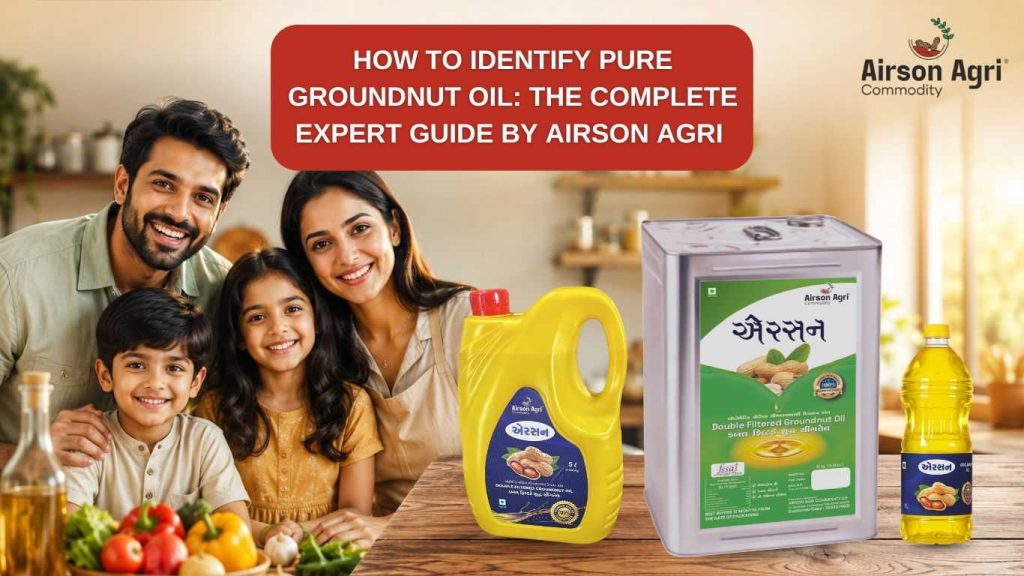
How to Identify Pure Groundnut Oil: The Complete Expert Guide by Airson Agri
Introduction
Choosing the right cooking oil is one of the most important decisions for your family’s health or your food business. However, with so many brands available in the market, identifying pure groundnut oil has become increasingly challenging. Reports of edible oil adulteration, misleading labels, and low-quality products have made consumers, restaurants, hotels, and food manufacturers more cautious than ever.
If you are wondering how to identify pure groundnut oil, this expert guide will help you understand the key signs of purity, the common indicators of adulteration, and what to look for before making a purchase. Whether you buy cooking oil for your home or in bulk for commercial use, knowing how to check oil quality helps you make a safer and smarter choice.
At Airson Agri, we believe that quality begins at the source. As a trusted manufacturer and supplier of premium Double Filtered Groundnut Oil, we follow stringent quality control processes, modern manufacturing practices, and food safety standards to deliver oil that meets the expectations of households, restaurants, hotels, food processors, and wholesale buyers across India and international markets.
Unlike heavily processed alternatives, Airson Agri Double Filtered Groundnut Oil retains its natural aroma, authentic taste, and high frying performance while maintaining consistent quality in every batch. Every pack reflects our commitment to purity, transparency, and customer trust.
Featured Snippet: How Can You Identify Pure Groundnut Oil?
You can identify pure groundnut oil by checking its natural roasted peanut aroma, clear golden-yellow colour, smooth texture, pleasant nutty taste, high smoke point, and certifications such as FSSAI. Purchasing directly from a trusted manufacturer like Airson Agri also helps ensure consistent quality, authenticity, and food safety.
In the following sections, you’ll discover practical home checks, laboratory quality tests, certification standards, and expert buying tips that make it easier to identify original groundnut oil and avoid fake or adulterated cooking oils with confidence.
How to Identify Pure Groundnut Oil: The Complete Expert Guide by Airson Agri
Choosing the right cooking oil is one of the most important decisions for your family’s health or your food business. However, with so many brands available in the market, identifying pure groundnut oil has become increasingly challenging. Reports of edible oil adulteration, misleading labels, and low-quality products have made consumers, restaurants, hotels, and food manufacturers more cautious than ever.
If you are wondering how to identify pure groundnut oil, this expert guide will help you understand the key signs of purity, the common indicators of adulteration, and what to look for before making a purchase. Whether you buy cooking oil for your home or in bulk for commercial use, knowing how to check oil quality helps you make a safer and smarter choice.
At Airson Agri, we believe that quality begins at the source. As a trusted manufacturer and supplier of premium Double Filtered Groundnut Oil, we follow stringent quality control processes, modern manufacturing practices, and food safety standards to deliver oil that meets the expectations of households, restaurants, hotels, food processors, and wholesale buyers across India and international markets.
Unlike heavily processed alternatives, Airson Agri Double Filtered Groundnut Oil retains its natural aroma, authentic taste, and high frying performance while maintaining consistent quality in every batch. Every pack reflects our commitment to purity, transparency, and customer trust.
Featured Snippet: How Can You Identify Pure Groundnut Oil?
You can identify pure groundnut oil by checking its natural roasted peanut aroma, clear golden-yellow colour, smooth texture, pleasant nutty taste, high smoke point, and certifications such as FSSAI. Purchasing directly from a trusted manufacturer like Airson Agri also helps ensure consistent quality, authenticity, and food safety.
In the following sections, you’ll discover practical home checks, laboratory quality tests, certification standards, and expert buying tips that make it easier to identify original groundnut oil and avoid fake or adulterated cooking oils with confidence.
Why Groundnut Oil Gets Adulterated
The demand for pure groundnut oil continues to grow because consumers value its rich flavour, excellent frying performance, and nutritional benefits. However, this growing demand has also led to an increase in edible oil adulteration. Understanding why adulteration happens helps buyers make informed decisions and choose products from trusted manufacturers like Airson Agri.
Why Do Some Manufacturers Mix Cheaper Oils?
Groundnut oil costs more to produce than many other edible oils because it requires quality peanuts, careful processing, and strict quality control. To increase profit margins, some manufacturers or traders may dilute groundnut oil with lower-cost vegetable oils while marketing the product as pure groundnut oil.
Although food regulations require accurate labelling of blended oils, undisclosed adulteration is misleading and compromises product quality. This practice can reduce the oil’s natural aroma, alter its flavour, and affect its cooking performance.
Choosing a reliable manufacturer that follows transparent sourcing, hygienic production, and recognised food safety standards is the best way to minimise this risk.
Common Oils Mixed with Groundnut Oil
Unscrupulous suppliers may mix groundnut oil with less expensive edible oils to lower production costs. Some commonly used oils include:
Palmolein Oil – Often blended because it is more economical and widely available.
Soybean Oil – Used to reduce manufacturing costs while maintaining a similar appearance.
Cottonseed Oil – Sometimes mixed due to its neutral colour and flavour.
Rice Bran Oil – May be included in blended oils when properly declared on the label.
Other Vegetable Oils – Various refined oils may be added depending on market prices.
These oils are not inherently unsafe when sold and labelled correctly. However, problems arise when manufacturers falsely market blended oils as 100% pure groundnut oil without proper disclosure.
At Airson Agri, product quality and transparency remain top priorities. Every batch of Double Filtered Groundnut Oil is produced with strict quality controls to deliver consistent purity, authentic flavour, and dependable performance.
Risks of Adulterated Groundnut Oil
Adulterated cooking oil may not deliver the same quality or performance as genuine groundnut oil. Depending on the nature of the adulteration, buyers may experience several issues:
Reduced natural peanut aroma and authentic taste.
Lower smoke point, which may affect frying quality.
Increased oil absorption during deep frying.
Inconsistent colour, texture, or cooking performance.
Poor shelf life and faster deterioration.
Reduced nutritional value compared with pure groundnut oil.
Loss of consumer trust, especially for restaurants, hotels, and food manufacturers.
For commercial kitchens, even small quality differences can influence the taste, texture, and consistency of fried foods such as samosas, bhajiyas, pakoras, namkeen, and snacks.
Why Quality Matters for Health
Choosing a high-quality cooking oil supports better food preparation and gives consumers greater confidence in what they serve. Pure groundnut oil naturally contains monounsaturated fats, Vitamin E, and antioxidants, while maintaining excellent stability for high-temperature cooking.
By contrast, an undisclosed adulterated product may not provide the expected nutritional profile or cooking performance. This is why experts recommend purchasing cooking oil from manufacturers that follow recognised quality standards, maintain hygienic production facilities, and provide clear product information.
Whether you are buying oil for your family, restaurant, hotel, catering business, or food manufacturing unit, selecting a trusted supplier helps ensure consistent quality in every batch.
At Airson Agri, quality begins with carefully selected groundnuts and continues through modern manufacturing, rigorous quality testing, hygienic packaging, and reliable distribution. Our commitment to purity helps customers cook with confidence while enjoying the authentic flavour and performance of premium Double Filtered Groundnut Oil.
Quick Fact
Edible oil adulteration is one of the most searched food safety topics worldwide because consumers increasingly want to know whether their cooking oil is genuine, nutritious, and safe. The simplest way to reduce this risk is to buy from trusted manufacturers that maintain transparent sourcing, strict quality control, and recognised food safety certifications.
10 Easy Ways to Identify Pure Groundnut Oil
With dozens of cooking oil brands available today, identifying pure groundnut oil can feel confusing. Attractive packaging and marketing claims do not always guarantee quality. Fortunately, a few simple checks can help you distinguish original groundnut oil from low-quality or adulterated products.
Here are ten practical ways experts recommend for checking the purity of groundnut oil before you buy or use it.
1. Check the Natural Aroma
One of the easiest ways to identify pure groundnut oil is by its aroma.
High-quality groundnut oil has a pleasant, mild roasted peanut fragrance that feels natural and fresh. The aroma should never smell excessively strong, artificial, stale, or rancid.
Premium Double Filtered Groundnut Oil, like the oil manufactured by Airson Agri, preserves the natural nutty aroma because the filtration process removes impurities without stripping away the oil’s authentic character.
Expert Tip: If the oil has little or no aroma, or smells unusually chemical-like, it deserves closer inspection.
2. Observe the Colour
Colour provides another useful indication of quality.
Pure groundnut oil usually appears clear with a natural golden-yellow hue. The exact shade may vary slightly depending on the peanut variety, harvest season, and processing method.
Avoid judging quality solely by colour. Some refined or blended oils can appear similar through additional processing.
Instead, evaluate colour together with aroma, texture, certifications, and the manufacturer’s reputation.
3. Perform a Taste Test
Authentic groundnut oil delivers a clean, mild, nutty flavour that enhances food without overpowering it.
When used for cooking, it should provide:
A pleasant natural taste.
No bitterness.
No chemical aftertaste.
No unpleasant odour.
Restaurants and professional chefs often prefer premium Double Filtered Groundnut Oil because it maintains the authentic taste of traditional Indian dishes.
4. Check the Texture and Viscosity
Pure groundnut oil should feel smooth, clean, and consistent.
It should neither appear excessively thick nor unusually watery. The oil should pour evenly and maintain a uniform consistency without visible impurities or unusual separation.
Good-quality oil also leaves a light, clean feel rather than a sticky or greasy residue.
5. Observe Its Smoke Point During Cooking
Groundnut oil is widely recognised for its high smoke point, making it ideal for deep frying, stir-frying, and commercial kitchens.
When heated properly, premium groundnut oil:
Heats evenly.
Produces minimal smoke at normal frying temperatures.
Helps food cook uniformly.
Supports crisp, golden results with less oil absorption.
If oil begins smoking unusually early or produces excessive foam under normal cooking conditions, it may indicate poor quality, improper storage, or degradation. However, smoke alone cannot confirm adulteration.
This is one reason why hotels, restaurants, snack manufacturers, and caterers often choose Airson Agri Double Filtered Groundnut Oil for consistent frying performance.
6. Verify the Product Label
Always read the label before purchasing.
A trustworthy product should clearly display:
Product name.
Ingredient declaration.
Net quantity.
Manufacturing details.
Batch number.
Best-before date.
Manufacturer information.
Customer support details.
If the product claims to be 100% pure groundnut oil, the label should accurately reflect that claim and comply with applicable food regulations.
Transparent labelling demonstrates the manufacturer’s commitment to quality and accountability.
7. Check FSSAI and Other Quality Certifications
Food safety certifications help buyers make informed purchasing decisions.
Look for recognised certifications such as:
FSSAI Licence Number
AGMARK (where applicable)
Food-grade packaging compliance
Manufacturer quality assurance practices
These certifications indicate that the product is manufactured under recognised food safety regulations. However, certifications should be considered alongside the manufacturer’s reputation and quality processes.
At Airson Agri, every batch of Double Filtered Groundnut Oil is produced under stringent quality controls to ensure consistency, safety, and customer confidence.
8. Examine the Packaging Quality
Quality packaging protects oil from light, air, moisture, and contamination.
Before buying, inspect the container carefully.
Check for:
Proper sealing.
No leakage.
No dents or damage.
Clearly printed labels.
Manufacturing and expiry dates.
Tamper-evident packaging.
For commercial users, durable packaging also helps preserve oil quality during transportation and storage.
Airson Agri supplies premium 15-litre Double Filtered Groundnut Oil in robust packaging designed for safe handling and dependable performance in restaurants, hotels, and food industries.
9. Evaluate the Manufacturer’s Credibility
The manufacturer often tells you more than the label itself.
Before purchasing, consider:
Years of industry experience.
Manufacturing facilities.
Quality testing procedures.
Customer reviews.
Supply consistency.
Business transparency.
Food safety compliance.
Established manufacturers invest in better raw materials, advanced production systems, and rigorous quality checks because their reputation depends on delivering consistent products.
10. Buy Directly from Trusted Manufacturers Like Airson Agri
Perhaps the simplest way to avoid counterfeit or low-quality cooking oil is to purchase directly from a reliable manufacturer.
Buying from Airson Agri offers several advantages:
Premium Double Filtered Groundnut Oil.
Carefully selected quality groundnuts.
Strict manufacturing standards.
Modern production facilities.
Consistent quality control.
Reliable bulk supply.
Hygienic packaging.
Trusted by households, restaurants, hotels, food manufacturers, wholesalers, and exporters.
Whether you need 15-litre packs for commercial kitchens or bulk quantities for industrial use, buying directly from the manufacturer improves traceability, product consistency, and long-term value.
Featured Snippet: What Is the Easiest Way to Identify Pure Groundnut Oil?
The easiest way to identify pure groundnut oil is by checking its natural roasted peanut aroma, clear golden-yellow colour, smooth texture, high smoke point, food safety certifications, quality packaging, and the credibility of the manufacturer. Buying directly from trusted manufacturers like Airson Agri offers greater confidence in product authenticity and consistent quality.
Home Tests to Check Groundnut Oil Purity
Many people search online for how to check pure groundnut oil at home before buying or using it. While no home test can guarantee 100% purity, a few simple observations can help you identify obvious signs of poor-quality or adulterated oil. For complete assurance, however, laboratory testing remains the most reliable method.
Here are some practical home tests you can perform.
1. Refrigeration Test
The refrigeration test is one of the most commonly discussed methods for checking cooking oil quality.
How to perform the test:
Pour a small amount of groundnut oil into a clean glass container.
Place it in a refrigerator for several hours.
Observe any changes in appearance.
Pure groundnut oil may become slightly cloudy or thicker at lower temperatures because of the natural behaviour of its fatty acids. However, this reaction varies depending on the oil’s composition and storage conditions. Therefore, refrigeration alone cannot confirm whether the oil is pure or adulterated.
Use this test only as one observation, not as definitive proof of authenticity.
2. Palm Rub Test
This quick test helps evaluate the oil’s aroma and texture.
How to perform the test:
Place a few drops of groundnut oil on your palm.
Rub it gently between both hands.
Smell the oil immediately.
Premium Double Filtered Groundnut Oil should release a pleasant, mild roasted peanut aroma. The oil should feel smooth, clean, and non-sticky.
If the oil has an unusually strong chemical smell, an unpleasant odour, or leaves an excessively greasy residue, it may indicate poor quality or improper storage.
3. Observe for Sedimentation
Carefully inspect the oil before use.
Look for:
Suspended particles.
Excessive cloudiness at room temperature.
Unusual separation.
Visible impurities.
High-quality filtered groundnut oil generally appears clean and uniform. A small amount of natural sediment may occasionally occur in minimally processed oils, but excessive deposits or inconsistent appearance should prompt further evaluation.
Properly manufactured Airson Agri Double Filtered Groundnut Oil undergoes rigorous filtration to deliver consistently clean, high-quality oil.
4. Watch the Oil While Heating
Heating behaviour provides useful information about cooking performance.
When heated under normal cooking conditions, quality groundnut oil should:
Heat evenly.
Produce minimal smoke before reaching frying temperature.
Maintain a stable appearance.
Deliver crisp frying results.
If the oil smokes excessively, foams heavily, develops an unpleasant odour, or darkens unusually quickly, it may indicate that the oil has deteriorated, has been improperly stored, or has already been repeatedly used. These observations do not necessarily prove adulteration, but they do suggest the oil should be evaluated carefully.
5. Perform a Simple Visual Inspection
Sometimes the simplest checks are the most valuable.
Before purchasing or using any cooking oil, inspect:
The colour.
Overall clarity.
Packaging condition.
Seal integrity.
Manufacturing date.
Best-before date.
FSSAI licence details.
Manufacturer information.
Pure groundnut oil typically has a clear golden-yellow appearance and comes in properly sealed, food-grade packaging with complete product information.
Buying directly from trusted manufacturers like Airson Agri further reduces the risk of purchasing counterfeit or low-quality products.
Limitations of Home Tests
Although home tests are useful for identifying obvious quality concerns, they have important limitations.
Home observations cannot accurately measure:
Free Fatty Acid (FFA) levels.
Peroxide Value.
Fatty acid composition.
Moisture content.
Chemical adulteration.
Purity percentage.
Many adulterated oils closely resemble genuine groundnut oil in colour, texture, and appearance. Likewise, natural variations in temperature or storage can affect how pure oil behaves during refrigeration or heating.
For this reason, food laboratories use advanced analytical methods and specialised equipment to determine whether an edible oil meets recognised quality standards.
The safest approach combines simple visual checks with purchasing from a reputable manufacturer that follows strict quality control procedures.
At Airson Agri, every batch of Double Filtered Groundnut Oil is carefully tested, hygienically processed, and packaged under stringent quality standards to ensure consistent purity, authentic flavour, and dependable performance for households, restaurants, hotels, food manufacturers, and wholesale buyers.
AI Answer Box
Can I test groundnut oil at home?
Yes, you can perform simple home checks such as evaluating the oil’s aroma, colour, texture, refrigeration behaviour, heating performance, and packaging quality. However, these methods provide only preliminary observations. Laboratory testing remains the most accurate way to verify the purity, quality, and authenticity of groundnut oil. Choosing a trusted manufacturer like Airson Agri offers additional confidence in product consistency and food safety.
Laboratory Tests Used to Verify Groundnut Oil Quality
While home tests provide useful clues, they cannot scientifically confirm whether a cooking oil is pure. This is where laboratory testing becomes essential. Accredited food laboratories use advanced equipment to evaluate the chemical and physical properties of edible oils, ensuring they meet recognised quality and safety standards.
Trusted manufacturers such as Airson Agri rely on rigorous quality control and laboratory analysis to maintain consistent product quality. These tests help verify purity, freshness, stability, and overall performance before the oil reaches consumers.
Let’s understand the most important laboratory tests in simple terms.
1. Free Fatty Acid (FFA) Test
The Free Fatty Acid (FFA) test measures the amount of free fatty acids present in the oil.
In simple terms, it indicates how fresh and well-processed the oil is.
When groundnuts are damaged, stored improperly, or exposed to excess moisture, the FFA level increases. A higher FFA value may affect the oil’s flavour, aroma, shelf life, and frying performance.
A well-manufactured Double Filtered Groundnut Oil should have FFA levels within the limits specified by applicable quality standards, reflecting careful processing and proper storage.
2. Peroxide Value (PV)
The Peroxide Value (PV) measures the early stages of oxidation.
Simply put, it shows whether the oil has started to deteriorate due to exposure to air, heat, or light.
Fresh groundnut oil typically has a low peroxide value. As oxidation progresses, the oil may gradually lose its pleasant aroma and eventually develop a rancid smell or off-flavour.
Maintaining a low peroxide value is essential for preserving freshness, taste, and shelf life.
3. Moisture Content
Although cooking oil appears dry, small amounts of water can still be present.
The Moisture Content Test measures how much water remains in the oil after processing.
Low moisture is important because excess water can:
Reduce shelf life.
Encourage spoilage.
Affect frying performance.
Increase foaming during cooking.
Quality manufacturers carefully control moisture levels throughout production to ensure stable, long-lasting edible oil.
4. Iodine Value
The Iodine Value (IV) indicates the degree of unsaturation in the oil.
In simpler language, it measures the type of natural fats present in groundnut oil.
This value helps laboratories:
Confirm the oil’s identity.
Detect unusual blending with other oils.
Evaluate nutritional characteristics.
Verify compliance with quality standards.
Each edible oil has its own characteristic iodine value, making this an important parameter for authenticity testing.
5. Saponification Value
The Saponification Value (SV) measures the average size of the fatty acid molecules in the oil.
Although the name sounds technical, the purpose is straightforward.
This test helps laboratories:
Confirm the oil’s chemical composition.
Detect possible adulteration.
Verify consistency between production batches.
Every edible oil has a typical saponification value. Significant deviations may indicate blending with other oils or quality issues that require further investigation.
6. Fatty Acid Profile
One of the most reliable ways to verify pure groundnut oil is through its Fatty Acid Profile.
Using advanced laboratory instruments such as gas chromatography, scientists measure the proportion of different fatty acids naturally present in the oil.
Groundnut oil typically contains a balanced combination of:
Monounsaturated fats (MUFA) – known for their stability and suitability for cooking.
Polyunsaturated fats (PUFA) – essential dietary fats.
Saturated fats – naturally present in smaller amounts.
This unique fatty acid pattern acts like a fingerprint. If the profile differs significantly from expected values, it may indicate that another oil has been mixed with the product.
7. Purity Analysis
Purity Analysis combines several laboratory tests to determine whether the oil is genuinely groundnut oil and whether it complies with recognised quality standards.
Specialists evaluate:
Chemical composition.
Physical properties.
Fatty acid profile.
Moisture levels.
Oxidation status.
Possible adulteration markers.
Overall product consistency.
This comprehensive evaluation provides the highest level of confidence in the oil’s authenticity and quality.
At Airson Agri, quality assurance is an integral part of the manufacturing process. Every batch of Double Filtered Groundnut Oil undergoes stringent quality checks to ensure consistency, purity, and dependable performance for households, restaurants, hotels, food manufacturers, wholesalers, and export markets.
Why Laboratory Testing Matters
Laboratory testing protects both consumers and businesses by ensuring that cooking oil meets established quality standards before it reaches the market. It helps manufacturers maintain consistency, supports food safety, and builds long-term customer trust.
When purchasing groundnut oil, choose manufacturers that prioritise quality control, transparent production practices, and rigorous testing. A trusted supplier like Airson Agri combines carefully selected groundnuts, modern manufacturing technology, hygienic processing, and comprehensive quality assurance to deliver premium Double Filtered Groundnut Oil with reliable quality in every pack.
Expert Insight
Laboratory testing is the most accurate method for verifying groundnut oil quality. While home tests offer basic observations, parameters such as Free Fatty Acid (FFA), Peroxide Value, Moisture Content, Iodine Value, Saponification Value, Fatty Acid Profile, and Purity Analysis provide scientific evidence of an oil’s freshness, authenticity, stability, and overall quality.
FSSAI, AGMARK & Quality Standards Every Buyer Should Check
When purchasing pure groundnut oil, many buyers focus only on the price or brand name. However, the most reliable way to evaluate quality is by checking whether the product complies with recognised food safety standards and is manufactured under strict quality control.
Whether you are a household consumer, restaurant owner, hotel, distributor, wholesaler, or food manufacturer, understanding certifications like FSSAI and AGMARK helps you make a more informed purchasing decision.
At Airson Agri, quality is not just a promise—it is built into every stage of production. From sourcing premium groundnuts to hygienic processing, filtration, testing, and packaging, every batch of Double Filtered Groundnut Oil is produced with a strong focus on consistency, safety, and customer satisfaction.
FSSAI Standards for Groundnut Oil
The Food Safety and Standards Authority of India (FSSAI) is India’s national food safety regulator. It establishes standards for the manufacturing, processing, packaging, storage, distribution, and sale of food products, including edible oils.
Every legitimate edible oil manufacturer in India must obtain an FSSAI licence and comply with the regulations prescribed under the Food Safety and Standards Act.
When purchasing groundnut oil, always check that the label includes:
A valid FSSAI Licence Number.
Complete manufacturer details.
Batch or lot number.
Manufacturing and best-before dates.
Ingredient declaration.
Net quantity and packaging information.
An FSSAI licence indicates that the manufacturer operates under recognised food safety regulations and is subject to regulatory oversight.
At Airson Agri, our manufacturing processes follow stringent food safety practices to ensure every pack of Double Filtered Groundnut Oil meets applicable regulatory requirements and delivers reliable quality.
What is AGMARK Certification?
AGMARK is a quality certification issued under the Agricultural Produce (Grading and Marking) Act. Unlike FSSAI, which focuses on food safety regulations, AGMARK primarily certifies the grade and quality of agricultural products, including certain edible oils.
When applicable, AGMARK certification indicates that the product has been evaluated against defined quality parameters such as:
Purity.
Physical characteristics.
Chemical quality.
Grading standards.
Overall product consistency.
For buyers looking for additional quality assurance, AGMARK serves as another useful indicator alongside FSSAI compliance.
Food Safety Compliance Matters
High-quality cooking oil depends on much more than the raw material. Every stage of production must follow strict hygiene and quality control procedures.
A responsible manufacturer should implement:
Hygienic processing environments.
Quality inspection of raw groundnuts.
Controlled filtration processes.
Batch-wise quality testing.
Proper storage conditions.
Food-grade packaging materials.
Traceability throughout production.
These practices help preserve the oil’s natural aroma, flavour, freshness, and stability while reducing the risk of contamination.
At Airson Agri, food safety is integrated into every step of manufacturing to ensure consistent quality for households, restaurants, hotels, food manufacturers, and export customers.
Manufacturing Standards You Should Look For
Choosing the right manufacturer is just as important as choosing the right oil.
Before buying, consider whether the manufacturer demonstrates:
Modern manufacturing facilities.
Advanced filtration technology.
Strict quality control procedures.
Transparent sourcing practices.
Compliance with food safety regulations.
Reliable packaging systems.
Consistent product quality.
Strong industry reputation.
Established manufacturers invest in quality because consistency builds long-term customer trust.
With years of expertise in edible oil manufacturing, Airson Agri has earned the confidence of businesses across India by delivering premium Double Filtered Groundnut Oil with dependable quality, authentic taste, and excellent frying performance.
Why Certifications Matter
Certifications cannot replace careful manufacturing, but they provide valuable assurance that the product has been produced under recognised standards.
When combined with a trusted manufacturer’s reputation, certifications help buyers:
Make informed purchasing decisions.
Verify regulatory compliance.
Improve confidence in product quality.
Ensure proper labelling and traceability.
Reduce the risk of purchasing counterfeit or misleading products.
Choose suppliers committed to consistent manufacturing practices.
For commercial buyers such as restaurants, hotels, caterers, wholesalers, and food processing companies, selecting a manufacturer with strong quality systems helps ensure consistent cooking results and long-term supply reliability.
This is why businesses across India choose Airson Agri as a trusted manufacturer and supplier of premium Double Filtered Groundnut Oil.
People Also Ask
Is FSSAI enough to ensure groundnut oil purity?
An FSSAI licence confirms that the manufacturer complies with India’s food safety regulations. However, buyers should also evaluate the manufacturer’s reputation, quality control processes, transparent labelling, and overall manufacturing standards when assessing product quality.
Is AGMARK mandatory for groundnut oil?
No. AGMARK certification is not mandatory for all edible oils. It is a voluntary quality certification that indicates the product has been graded according to specified quality standards. Many buyers consider it an additional mark of quality assurance.
Which certification ensures purity?
No single certification alone guarantees purity. The best assurance comes from a combination of FSSAI compliance, robust quality control systems, recognised manufacturing standards, transparent sourcing, laboratory testing, and purchasing from trusted manufacturers like Airson Agri, who prioritise consistency and food safety throughout the production process.
Double Filtered vs Refined vs Cold Pressed Groundnut Oil
Groundnut oil is available in different forms, with double filtered, refined, and cold pressed being the most common. Although all three are extracted from peanuts (groundnuts), they differ significantly in their processing methods, nutritional profile, flavour, smoke point, shelf life, and cooking applications.
Consumers frequently search questions such as “Which groundnut oil is healthiest?“, “Is double filtered groundnut oil better than refined?”, and “Should I buy cold pressed or double filtered groundnut oil?” Understanding these differences will help you choose the right oil for your family’s health, cooking style, and budget.
Comparison Table
| Feature | Double Filtered Groundnut Oil | Refined Groundnut Oil | Cold Pressed Groundnut Oil |
|---|---|---|---|
| Processing Method | Mechanically extracted and filtered twice to remove impurities while retaining natural qualities | Highly refined through degumming, neutralization, bleaching, deodorization, and filtration | Extracted at low temperatures using traditional wooden or steel presses |
| Chemical Processing | No harsh chemical refining | Undergoes multiple refining processes | No chemical refining |
| Nutritional Value | Retains most natural antioxidants, Vitamin E, and healthy monounsaturated fats | Some nutrients and antioxidants are lost during refining | Highest retention of natural nutrients and antioxidants |
| Natural Aroma & Flavour | Mild roasted peanut aroma with authentic groundnut taste | Neutral flavour with almost no natural aroma | Rich peanut aroma and stronger flavour |
| Colour | Clear golden-yellow | Very light yellow or almost colourless | Deep golden-yellow |
| Smoke Point | Approximately 230°C – excellent for frying and daily cooking | Approximately 232–235°C – ideal for commercial high-heat cooking | Approximately 160–180°C – suitable for low to medium heat cooking |
| Shelf Life | Long shelf life with excellent stability | Longest shelf life | Shorter shelf life due to minimal processing |
| Best Uses | Everyday cooking, deep frying, restaurants, hotels, catering, food manufacturing | Commercial kitchens, repeated frying, processed food production | Salads, light sautéing, finishing oil, health-conscious cooking |
| Taste in Food | Enhances food with a balanced natural peanut flavour | Neutral taste | Distinct peanut flavour |
| Cost | Moderate and offers excellent value | Usually the most affordable | Premium-priced |
| Ideal For | Homes, restaurants, hotels, wholesalers, exporters, food manufacturers | Large-scale commercial food processing | Consumers seeking minimally processed cooking oil |
Why Airson Agri Double Filtered Groundnut Oil Offers the Perfect Balance
When choosing cooking oil, consumers often look for the perfect combination of natural nutrition, authentic taste, cooking performance, and affordability. This is where Airson Agri Double Filtered Groundnut Oil stands out.
Unlike refined oil, our double filtered groundnut oil undergoes minimal processing, helping preserve its naturally pleasant peanut aroma, golden colour, and essential nutrients. At the same time, it offers a high smoke point and excellent shelf stability, making it more practical for everyday Indian cooking than many cold pressed oils.
Why Choose Airson Agri Double Filtered Groundnut Oil?
✔ Premium quality groundnuts sourced carefully
✔ Double filtered to remove impurities while preserving natural goodness
✔ No harsh chemical refining process
✔ Rich in heart-friendly monounsaturated fats and natural Vitamin E
✔ High smoke point (around 230°C), ideal for frying, sautéing, and daily cooking
✔ Naturally mild peanut aroma and authentic taste
✔ Manufactured under strict hygiene and food safety standards
✔ Consistent quality trusted by households, restaurants, hotels, wholesalers, distributors, exporters, and food manufacturers
✔ Hygienically packed to preserve freshness and longer shelf life
Whether you’re a home cook, restaurant owner, hotel chef, food manufacturer, or global buyer, Airson Agri Double Filtered Groundnut Oil delivers the ideal balance between nutrition, flavour, stability, and value, making it one of the best choices for everyday cooking.
Featured Snippet
Which is better: double filtered, refined, or cold pressed groundnut oil?
Double filtered groundnut oil offers the best balance of natural flavour, nutrition, high smoke point, and shelf life. It is less processed than refined oil while providing greater cooking stability than cold pressed oil, making it ideal for everyday cooking.
Why Restaurants & Hotels Prefer Double Filtered Groundnut Oil
For restaurants, hotels, caterers, cloud kitchens, sweet shops, snack manufacturers, and commercial food businesses, cooking oil is more than just an ingredient—it’s a key factor that affects food quality, customer satisfaction, operating costs, and kitchen efficiency.
That’s why many professional chefs and food businesses prefer Double Filtered Groundnut Oil. It offers the ideal combination of high heat stability, authentic flavour, crisp frying results, lower oil absorption, and excellent value, making it one of the best cooking oils for commercial kitchens.
Whether you’re frying samosas, bhajiyas, pakoras, kachoris, puris, namkeen, fafda, sev, chips, or other deep-fried snacks, double filtered groundnut oil consistently delivers superior performance.
High Smoke Point for Continuous Frying
One of the biggest reasons commercial kitchens choose double filtered groundnut oil is its high smoke point of around 230°C.
A higher smoke point means the oil can tolerate high frying temperatures without breaking down quickly. This helps chefs maintain consistent cooking temperatures while reducing excessive smoke and preserving food quality.
It is ideal for:
Samosa frying
Bhajiya frying
Pakora frying
Kachori preparation
Fafda production
Namkeen manufacturing
Restaurant deep frying
Hotel buffet kitchens
Fast-food outlets
Catering operations
Less Oil Absorption Means Better Profits
Foods fried in high-quality double filtered groundnut oil tend to absorb less oil when cooked at the correct temperature.
Benefits include:
Crispier texture
Lighter food
Better taste
Reduced greasiness
Improved customer satisfaction
Lower oil consumption over time
This makes it an economical choice for restaurants serving hundreds of customers every day.
Superior Frying Performance
Professional chefs require an oil that performs consistently during long cooking hours.
Double filtered groundnut oil provides:
Even heat distribution
Faster frying
Uniform browning
Attractive golden colour
Excellent texture
Consistent cooking quality
Whether preparing pakoras during monsoon, crispy samosas, golden bhajiyas, or premium namkeen, the results remain consistently delicious.
Crispier Snacks That Customers Love
Texture plays a major role in customer satisfaction.
Double filtered groundnut oil helps create:
Crispy samosas
Crunchy bhajiyas
Light pakoras
Crisp fafda
Perfect sev
Fresh namkeen
Restaurant-quality fried snacks
Its natural characteristics help maintain crispness while enhancing the authentic flavour of traditional Indian snacks.
Longer Frying Cycles for Commercial Kitchens
Busy restaurants and hotels often fry food continuously throughout the day.
Because of its excellent heat stability, premium double filtered groundnut oil maintains its quality for longer frying cycles when used under proper frying practices.
This helps commercial kitchens:
Maintain consistent frying performance
Reduce frequent oil changes
Improve kitchen efficiency
Minimise cooking interruptions
Deliver consistent food quality during peak service hours
Cost-Effective for High-Volume Food Businesses
Every litre of cooking oil matters in commercial operations.
Double filtered groundnut oil offers excellent value because it provides:
Reliable frying performance
Reduced oil absorption
Longer usable frying life
Consistent food quality
High customer satisfaction
Better return on operating costs
For restaurants, hotels, caterers, snack manufacturers, and food processing businesses, it strikes the ideal balance between quality, performance, and affordability.
Why Commercial Kitchens Trust Airson Agri Double Filtered Groundnut Oil
At Airson Agri, we manufacture premium Double Filtered Groundnut Oil specifically designed to meet the demands of households as well as professional food businesses.
Our oil is trusted by:
Restaurants
Hotels
Caterers
Commercial kitchens
Sweet shops
Namkeen manufacturers
Food processors
Wholesalers
Distributors
Export buyers
We maintain strict quality control throughout sourcing, filtration, packaging, and distribution to ensure every batch delivers consistent taste, stability, and performance.
Whether you’re frying samosas, bhajiyas, pakoras, fafda, sev, chips, or namkeen, Airson Agri Double Filtered Groundnut Oil helps you serve delicious food while maximizing kitchen efficiency.
Featured Snippet
Why do restaurants prefer double filtered groundnut oil?
Restaurants and hotels prefer double filtered groundnut oil because it has a high smoke point, absorbs less into food, delivers crispier fried snacks, performs consistently during long frying hours, and offers excellent value for commercial kitchens.
Groundnut Oil Health Benefits Backed by Nutrition
Groundnut oil is one of the most widely used cooking oils in Indian households and commercial kitchens, not only for its pleasant taste and versatility but also for its nutritional profile. When consumed in moderation as part of a balanced diet, pure double filtered groundnut oil provides healthy fats, natural antioxidants, and essential nutrients that support overall well-being.
Let’s explore the scientifically recognized nutritional benefits of groundnut oil and why it remains a preferred choice for everyday cooking.
Healthy Fats That Support Overall Wellness
Groundnut oil is naturally rich in monounsaturated fatty acids (MUFAs) and polyunsaturated fatty acids (PUFAs), which are considered healthier dietary fats compared to trans fats.
These healthy fats help:
Support a balanced diet
Provide long-lasting energy
Replace unhealthy saturated and trans fats when used appropriately
Contribute to normal body functions
Choosing a cooking oil rich in healthy unsaturated fats is an important part of maintaining a nutritious eating pattern.
Naturally Rich in Vitamin E
Pure groundnut oil is an excellent natural source of Vitamin E, a fat-soluble vitamin known for its antioxidant properties.
Vitamin E helps:
Protect cells from oxidative stress
Support healthy skin
Contribute to normal immune function
Promote overall wellness
Because double filtered groundnut oil undergoes minimal processing, it helps retain more of its naturally occurring Vitamin E compared to heavily refined oils.
Contains Natural Antioxidants
Groundnut oil contains naturally occurring antioxidant compounds that help protect the oil from oxidation while also contributing to its nutritional value.
Antioxidants help:
Combat oxidative stress
Protect cells from free radical damage
Support overall health as part of a balanced diet
Although antioxidants are beneficial, they work best when combined with a healthy lifestyle and a nutrient-rich diet.
Supports Heart-Friendly Cooking
Groundnut oil is widely recommended for everyday cooking because of its favourable fatty acid composition.
Its higher proportion of monounsaturated fats makes it a suitable choice for people looking to maintain a heart-conscious diet.
Replacing oils high in trans fats with oils containing healthier unsaturated fats may help support cardiovascular health when combined with:
A balanced diet
Regular physical activity
Healthy body weight
Medical advice where appropriate
Suitable for Everyday Cooking
One of the biggest advantages of double filtered groundnut oil is its versatility.
It is ideal for:
Daily home cooking
Deep frying
Stir-frying
Sautéing
Shallow frying
Restaurant cooking
Hotel kitchens
Food manufacturing
Its mild flavour complements Indian cuisine without overpowering the natural taste of food.
Naturally Cholesterol-Free
Like all vegetable oils, pure groundnut oil contains no dietary cholesterol.
For individuals aiming to maintain healthy cholesterol levels, choosing oils rich in unsaturated fats instead of trans fats or excessive saturated fats can be part of a heart-friendly eating plan.
It is important to remember that overall cholesterol levels are influenced by total diet, exercise, genetics, and lifestyle—not by one ingredient alone.
High Smoke Point for Healthier Cooking
Double filtered groundnut oil has a high smoke point of approximately 230°C, making it well suited for high-temperature cooking methods.
A high smoke point helps:
Maintain cooking stability
Reduce premature oil breakdown
Preserve flavour during frying
Produce crisp, evenly cooked foods
This makes it one of the preferred cooking oils for households, restaurants, hotels, and commercial kitchens.
Why Airson Agri Double Filtered Groundnut Oil is a Nutritious Choice
At Airson Agri, we manufacture premium Double Filtered Groundnut Oil using carefully selected groundnuts and hygienic production practices.
Our oil offers:
✔ Naturally rich healthy unsaturated fats
✔ Natural source of Vitamin E
✔ Pleasant peanut aroma and authentic taste
✔ High smoke point for versatile cooking
✔ Minimal processing to preserve natural qualities
✔ Consistent quality and food safety standards
✔ Suitable for households, restaurants, hotels, food manufacturers, wholesalers, and exporters
When you choose Airson Agri Double Filtered Groundnut Oil, you’re choosing a cooking oil that combines great taste, reliable cooking performance, and nutritional value for everyday use.
Featured Snippet
What are the health benefits of groundnut oil?
Pure groundnut oil is rich in healthy monounsaturated fats, natural Vitamin E, and antioxidants. It is naturally cholesterol-free, has a high smoke point for stable cooking, and supports a balanced diet when consumed in moderation as part of a healthy lifestyle.
Important Health Disclaimer
The nutritional benefits of groundnut oil should be considered as part of an overall balanced diet and healthy lifestyle. No single food or cooking oil can prevent, treat, or cure any disease. Individuals with specific medical conditions or peanut allergies should consult a qualified healthcare professional before making dietary changes.
Groundnut Oil vs Other Cooking Oils
Choosing the right cooking oil can significantly impact the taste of your food, cooking performance, and overall nutrition. With so many options available, consumers often ask “Which cooking oil is best for daily use?“, “Is groundnut oil healthier than sunflower oil?”, or “Which oil is best for deep frying?”
Each edible oil has its own nutritional profile, flavour, smoke point, and ideal cooking applications. Understanding these differences helps households, restaurants, hotels, caterers, and food manufacturers make informed decisions.
The comparison below highlights how Double Filtered Groundnut Oil compares with Sunflower Oil, Mustard Oil, Rice Bran Oil, and Soybean Oil across the factors that matter most.
Comparison Table
| Feature | Double Filtered Groundnut Oil | Sunflower Oil | Mustard Oil | Rice Bran Oil | Soybean Oil |
|---|---|---|---|---|---|
| Primary Fat Composition | Rich in monounsaturated fats (MUFAs) | Rich in polyunsaturated fats (PUFAs) | Rich in monounsaturated and omega-3 fats | Balanced MUFAs and PUFAs | Higher in polyunsaturated fats |
| Natural Flavour | Mild roasted peanut flavour | Neutral | Strong, pungent | Mild and neutral | Neutral |
| Smoke Point | Around 230°C | Around 225–232°C | Around 250°C | Around 232°C | Around 230–234°C |
| Best for Deep Frying | ⭐⭐⭐⭐⭐ Excellent | ⭐⭐⭐⭐ Very Good | ⭐⭐⭐ Good | ⭐⭐⭐⭐ Very Good | ⭐⭐⭐⭐ Very Good |
| Stability at High Heat | Excellent | Good | Very Good | Very Good | Good |
| Oil Absorption During Frying | Generally lower when used correctly | Moderate | Moderate | Moderate | Moderate |
| Nutritional Highlights | Natural Vitamin E, healthy unsaturated fats | Vitamin E, polyunsaturated fats | Omega-3 fatty acids, antioxidants | Gamma Oryzanol, Vitamin E | Omega-6 fatty acids, Vitamin K |
| Taste in Food | Enhances natural flavour without overpowering | Neutral taste | Strong flavour influences recipes | Neutral taste | Neutral taste |
| Ideal Cooking Uses | Frying, sautéing, stir-frying, Indian cuisine, snacks | Everyday cooking, baking, frying | Traditional Indian dishes, pickles, curries | Daily cooking, frying, stir-frying | General household cooking and frying |
| Restaurant & Hotel Use | Highly preferred for frying and commercial kitchens | Common | Limited to specific cuisines | Widely used | Widely used |
Groundnut Oil for Deep Frying
One of the biggest advantages of Double Filtered Groundnut Oil is its excellent performance during deep frying.
Its naturally high smoke point and heat stability make it suitable for preparing:
Samosas
Bhajiyas
Pakoras
Fafda
Kachoris
Pooris
Namkeen
French fries
Restaurant snacks
Commercial fried foods
Because it remains stable at high temperatures, it helps achieve crispy texture, uniform browning, and authentic flavour, making it a preferred choice for professional kitchens.
Nutritional Comparison
Every edible oil offers different nutritional benefits.
Double Filtered Groundnut Oil is valued because it naturally contains:
Healthy monounsaturated fats (MUFAs)
Polyunsaturated fats (PUFAs)
Natural Vitamin E
Naturally cholesterol-free composition
Sunflower oil is rich in Vitamin E, mustard oil contains omega-3 fatty acids, rice bran oil is known for gamma oryzanol, while soybean oil provides polyunsaturated fats. The best choice depends on your cooking habits, dietary preferences, and nutritional needs.
Taste Makes a Difference
The flavour of cooking oil can influence the final taste of your food.
Groundnut Oil offers a mild roasted peanut flavour that enhances Indian recipes without overpowering them.
Sunflower Oil has a neutral taste, making it suitable for a variety of dishes.
Mustard Oil delivers a strong, pungent flavour preferred in many regional cuisines.
Rice Bran Oil has a light, neutral taste.
Soybean Oil is also relatively neutral, making it versatile for general cooking.
For restaurants and snack manufacturers looking to preserve the authentic taste of fried foods, Double Filtered Groundnut Oil remains one of the most preferred options.
Smoke Point & Cooking Stability
The smoke point determines how well an oil performs at high temperatures.
Double Filtered Groundnut Oil offers:
High smoke point (around 230°C)
Excellent heat stability
Consistent frying performance
Reduced premature oil breakdown
Reliable results during continuous cooking
This makes it suitable for both home kitchens and commercial food operations where high-temperature cooking is common.
Why Airson Agri Double Filtered Groundnut Oil Stands Out
At Airson Agri, we manufacture premium Double Filtered Groundnut Oil using carefully selected groundnuts and advanced filtration processes that preserve the oil’s natural quality while ensuring excellent cooking performance.
Why Choose Airson Agri?
✔ Naturally rich in healthy unsaturated fats and Vitamin E
✔ Pleasant roasted peanut aroma and authentic flavour
✔ High smoke point for deep frying and everyday cooking
✔ Excellent heat stability for commercial kitchens
✔ Ideal for households, restaurants, hotels, caterers, wholesalers, distributors, exporters, and food manufacturers
✔ Manufactured under strict hygiene and food safety standards
✔ Consistent quality trusted by customers across India and international markets
Whether you’re preparing meals at home or operating a high-volume commercial kitchen, Airson Agri Double Filtered Groundnut Oil delivers the perfect combination of nutrition, flavour, stability, and frying performance.
Featured Snippet
Which cooking oil is better: groundnut, sunflower, mustard, rice bran, or soybean oil?
Each cooking oil has unique advantages. Double filtered groundnut oil stands out for its balanced nutrition, natural flavour, high smoke point, excellent frying stability, and versatility, making it one of the best choices for both household and commercial cooking.
How to Choose the Best Groundnut Oil Brand
Choosing the right groundnut oil brand is just as important as selecting the right type of oil. A trustworthy manufacturer follows strict quality standards, uses premium-quality peanuts, and provides complete transparency about sourcing, processing, and testing. Before purchasing, use the checklist below to ensure you’re buying safe, authentic, and high-quality groundnut oil.
1. Choose a Reputable Manufacturer
Start by researching the manufacturer. Established brands with years of experience are more likely to maintain consistent quality, follow food safety regulations, and invest in modern processing facilities.
What to check:
Years in the edible oil industry
Manufacturing infrastructure
Market reputation
Customer support and contact information
2. Verify Certifications
Certifications demonstrate that the oil has been produced under recognized food safety and quality standards.
Look for:
FSSAI License
AGMARK Certification (where applicable)
ISO 22000 Food Safety Management
HACCP Certification
Export certifications (for international buyers)
These certifications indicate that the manufacturer follows standardized production and quality control practices.
3. Check the Source of Peanuts
The quality of groundnut oil begins with the quality of the peanuts used.
Choose brands that clearly mention:
Origin of the peanuts
High-grade raw material
Fresh seasonal procurement
Reliable sourcing from trusted farmers
Quality raw materials generally result in better flavor, nutritional value, and shelf life.
4. Inspect the Packaging
Good packaging protects oil from light, air, and contamination, helping preserve freshness and quality.
A reliable product should have:
Properly sealed packaging
Manufacturing and expiry dates
Batch number
Nutritional information
Storage instructions
Manufacturer details
Avoid products with damaged, leaking, or tampered packaging.
5. Read Customer Reviews
Customer reviews can provide valuable insights into product quality, taste, consistency, and overall satisfaction.
Look for feedback on:
Aroma and flavor
Cooking performance
Product freshness
Packaging quality
Delivery experience
While individual reviews may vary, consistent positive feedback is usually a good indicator of reliability.
6. Check Freshness
Freshly processed groundnut oil generally retains better flavor, aroma, and nutritional properties.
Before buying, verify:
Manufacturing date
Best-before period
Storage recommendations
Whenever possible, choose recently packed products rather than older stock.
7. Look for Brand Transparency
A trustworthy manufacturer openly shares information about its products and manufacturing practices.
Transparent brands typically provide:
Processing method (cold-pressed, double filtered, or refined)
Ingredient details
Manufacturing location
Quality certifications
Company information
Customer support channels
Brands that clearly communicate this information help consumers make informed purchasing decisions.
8. Ensure Quality Testing
Every batch of edible oil should undergo rigorous quality testing before reaching consumers.
Reliable manufacturers perform tests for:
Purity
Moisture content
Free Fatty Acid (FFA) levels
Peroxide Value
Microbiological safety
Compliance with food safety standards
Consistent laboratory testing helps ensure that the oil meets quality specifications and remains safe for consumption.
Quick Checklist Before You Buy
| Factor | What to Look For |
|---|---|
| Manufacturer | Established and reputable company |
| Certifications | FSSAI, AGMARK, ISO, HACCP |
| Peanut Source | High-quality, traceable raw material |
| Packaging | Properly sealed with complete labeling |
| Customer Reviews | Consistently positive feedback |
| Freshness | Recent manufacturing date |
| Transparency | Clear sourcing and processing details |
| Quality Testing | Batch-wise laboratory testing |
Bottom Line: The best groundnut oil brand isn’t determined by price alone. Choose a manufacturer that combines premium raw materials, recognized certifications, transparent practices, rigorous quality testing, and consistent customer satisfaction. Investing a few extra minutes in checking these factors can help you select a safer, fresher, and higher-quality cooking oil for your family or business.
Why Airson Agri is Trusted Across India
When purchasing groundnut oil in bulk, quality, consistency, and reliability matter just as much as price. Whether you’re a wholesaler, hotel, restaurant, food manufacturer, or distributor, choosing the right supplier ensures consistent cooking performance, timely deliveries, and long-term value.
Airson Agri has earned the trust of businesses across India by delivering premium-quality Double Filtered Groundnut Oil that meets stringent food safety and quality standards. As a Gujarat-based manufacturer, we combine traditional expertise with modern production technology to supply fresh, hygienically processed edible oils for commercial and industrial applications.
Leading Groundnut Oil Manufacturer in Gujarat
Gujarat is one of India’s largest groundnut-producing states, making it an ideal location for manufacturing premium-quality groundnut oil. At Airson Agri, we source carefully selected peanuts and process them using advanced manufacturing practices to preserve their natural flavour, aroma, and cooking performance.
Our manufacturing facility follows strict quality control procedures at every stage—from raw material procurement to packaging—ensuring that every batch delivers consistent quality.
Premium Double Filtered Groundnut Oil
Our Double Filtered Groundnut Oil is processed to remove impurities while retaining its natural taste, golden colour, and excellent cooking characteristics. Its high smoke point and stability make it suitable for a wide range of commercial cooking applications, including deep frying, sautéing, and everyday food preparation.
It is widely preferred by businesses that require dependable oil performance without compromising on quality.
Strict Quality Checks at Every Stage
Quality is not left to chance. Every batch undergoes multiple quality inspections to ensure it meets established food safety and product quality standards.
Our quality assurance process includes:
Careful selection of raw peanuts
Hygienic processing and filtration
Batch-wise quality inspections
Secure and contamination-free packaging
Compliance with applicable food safety requirements
This systematic approach helps maintain product consistency across every order.
FSSAI-Compliant Manufacturing
Food safety is an essential part of our manufacturing process. Airson Agri operates in accordance with FSSAI guidelines and follows standardized procedures designed to maintain hygiene, product integrity, and traceability throughout production.
Our commitment to compliance gives distributors, retailers, and commercial buyers greater confidence in every purchase.
Preferred by Commercial Buyers
Airson Agri supplies groundnut oil to businesses that require reliable quality and uninterrupted supply.
Our customers include:
Hotels
Restaurants
Caterers
Food processing industries
Wholesale distributors
Retail chains
Commercial kitchens
Institutional buyers
By understanding the operational needs of commercial kitchens and food businesses, we provide products that support consistent cooking results and efficient procurement.
Bulk Supply for Businesses
We specialize in supplying 15 Litre Groundnut Oil packs that are ideal for high-volume commercial use. Businesses can also place bulk orders based on their operational requirements, making procurement simple and cost-effective.
Whether you need regular wholesale deliveries or large-volume supplies, our manufacturing and logistics capabilities are designed to support businesses of all sizes.
Consistent Quality You Can Depend On
For commercial buyers, consistency is critical. Every order should deliver the same colour, aroma, taste, and cooking performance.
Through standardized manufacturing processes, rigorous quality control, and reliable sourcing, Airson Agri strives to maintain uniform quality across every batch, helping businesses serve their customers with confidence.
Why Businesses Choose Airson Agri
| Feature | Benefit |
|---|---|
| Gujarat-based manufacturer | Access to quality groundnuts from a leading producing region |
| Double Filtered Groundnut Oil | Clean, consistent oil with natural flavour and excellent cooking performance |
| Modern manufacturing | Hygienic processing and standardized production |
| Strict quality checks | Consistent quality in every batch |
| FSSAI-compliant processes | Manufactured with food safety and hygiene in mind |
| Bulk supply capability | Reliable supply for wholesalers and commercial buyers |
| 15 Litre packs | Convenient packaging for hotels, restaurants, and food businesses |
| Commercial expertise | Serving distributors, food industries, retailers, and institutional buyers |
Partner with a Reliable Groundnut Oil Supplier
If you’re looking for a dependable groundnut oil manufacturer in Gujarat, a trusted bulk groundnut oil supplier, or a reliable source of Double Filtered Groundnut Oil for your business, Airson Agri is committed to delivering quality, consistency, and dependable service.
Whether you’re ordering 15 Litre Groundnut Oil for a restaurant, sourcing wholesale quantities for distribution, or supplying food manufacturing operations, our team is ready to support your business with premium products and reliable bulk supply.
Frequently Asked Questions (FAQs)
1. How can I identify pure groundnut oil?
Pure groundnut oil has a light golden-yellow colour, a mild nutty aroma, and a clean taste. It should be free from unusual odours, excessive foam, or sediment. Purchasing from a reputable manufacturer with FSSAI compliance and quality certifications is one of the most reliable ways to ensure purity.
2. How do I know if groundnut oil is fake?
Fake or adulterated groundnut oil may have an unusual smell, unnatural colour, poor taste, or inconsistent cooking performance. Laboratory testing is the most accurate way to confirm purity, while buying from trusted manufacturers significantly reduces the risk of adulteration.
3. What colour should pure groundnut oil be?
Pure groundnut oil is typically light golden yellow to pale amber, depending on the processing method. Cold-pressed and double-filtered oils may appear slightly darker than refined oils because they retain more of their natural characteristics.
4. Is double filtered groundnut oil pure?
Double-filtered groundnut oil is processed to remove impurities while retaining its natural flavour and aroma. Purity depends on the quality of the raw peanuts, manufacturing standards, and quality testing rather than the filtration process alone.
5. Which oil is best for frying?
Groundnut oil is widely preferred for frying because of its high smoke point, good oxidative stability, and mild flavour. It performs well for deep frying, shallow frying, and commercial cooking without significantly affecting the taste of food.
6. Is groundnut oil healthier than sunflower oil?
Both oils have nutritional benefits. Groundnut oil contains healthy monounsaturated fats and natural antioxidants, while sunflower oil is generally higher in vitamin E. The better choice depends on your cooking method, dietary needs, and overall eating habits.
7. Can I reuse groundnut oil?
Groundnut oil can be reused a limited number of times if it is filtered after use, not overheated, and stored properly. Discard the oil if it develops a dark colour, burnt smell, excessive foaming, or thick consistency.
8. What is the smoke point of groundnut oil?
Groundnut oil has a relatively high smoke point, typically around 225°C to 230°C, making it suitable for high-temperature cooking methods such as deep frying, stir-frying, roasting, and sautéing.
9. Does pure groundnut oil contain chemicals?
Pure groundnut oil itself does not contain added chemicals. However, refined oils may be processed using approved refining methods to remove impurities. Cold-pressed and double-filtered varieties undergo less processing while retaining more natural characteristics.
10. Where can I buy pure groundnut oil in bulk?
Bulk groundnut oil should be purchased directly from reputable manufacturers or authorized wholesale suppliers that follow FSSAI guidelines, maintain consistent quality standards, and offer proper packaging, documentation, and reliable delivery for commercial buyers.
11. Is groundnut oil good for everyday cooking?
Yes. Groundnut oil is suitable for everyday cooking due to its balanced fatty acid profile, pleasant flavour, and high smoke point. It can be used for frying, sautéing, baking, and regular household cooking as part of a balanced diet.
12. What is the difference between refined and double filtered groundnut oil?
Refined groundnut oil undergoes additional processing to remove impurities, colour, and odour. Double-filtered groundnut oil is filtered without extensive refining, helping preserve more of its natural aroma, flavour, and appearance while removing suspended particles.
13. Does pure groundnut oil have a strong smell?
Pure groundnut oil usually has a mild, pleasant nutty aroma. Cold-pressed oils may have a stronger natural fragrance, while refined oils generally have a more neutral smell due to additional processing.
14. How should groundnut oil be stored?
Store groundnut oil in a cool, dry place away from direct sunlight and heat. Keep the container tightly sealed after every use to minimize exposure to air, which helps preserve freshness and extends shelf life.
15. Is groundnut oil suitable for restaurants and hotels?
Yes. Groundnut oil is widely used by restaurants, hotels, caterers, and commercial kitchens because of its frying performance, stability at high temperatures, and ability to deliver consistent cooking results across large food volumes.
16. What certifications should I look for when buying groundnut oil?
Choose groundnut oil from manufacturers with FSSAI registration and other recognized quality certifications where applicable. These certifications indicate adherence to established food safety, hygiene, and quality management practices during production.
17. Why is Gujarat known for groundnut oil production?
Gujarat is one of India’s leading groundnut-producing states, providing access to high-quality peanuts for edible oil manufacturing. Its strong agricultural base and established processing infrastructure have made it a major hub for groundnut oil production.
18. What packaging is best for bulk groundnut oil?
Commercial buyers commonly choose 15-litre containers because they are convenient to handle, store, and transport. Properly sealed, food-grade packaging also helps maintain product quality during storage and distribution.
19. How long does pure groundnut oil last?
The shelf life depends on the processing method, packaging, and storage conditions. When stored correctly in a sealed container away from heat and sunlight, groundnut oil generally remains fresh until its stated best-before date.
20. Why choose Airson Agri for bulk groundnut oil?
Airson Agri is a Gujarat-based manufacturer specializing in Double Filtered Groundnut Oil for wholesalers, distributors, hotels, restaurants, and food industries. With modern manufacturing, strict quality checks, FSSAI-compliant processes, and reliable bulk supply, Airson Agri delivers consistent quality for commercial buyers across India.
Final Thoughts
Choosing pure groundnut oil is about more than appearance or price. The best way to ensure quality is to buy from a trusted manufacturer that follows strict quality standards, uses premium raw materials, and maintains transparent manufacturing practices.
Remember these key points before making your purchase:
Buy from reputable and trusted manufacturers.
Never judge groundnut oil by colour alone.
Check for FSSAI and other relevant quality certifications.
Understand whether the oil is cold-pressed, double filtered, or refined.
Prioritize consistent quality, safety, and reliability over cheaper alternatives.
Whether you’re purchasing for your home or sourcing oil for commercial use, investing in high-quality groundnut oil delivers better cooking performance, greater consistency, and peace of mind.
Choose Quality. Choose Airson Agri.
Looking for premium Double Filtered Groundnut Oil for your home, restaurant, hotel, food manufacturing unit, or wholesale business? Airson Agri is a trusted Gujarat-based manufacturer committed to delivering consistent quality through modern manufacturing, strict quality checks, and FSSAI-compliant processes.
From convenient 15 Litre packs to large-scale bulk orders, we supply premium groundnut oil to wholesalers, distributors, hotels, restaurants, caterers, and food industries across India and international markets.
Partner with Airson Agri for reliable quality, dependable supply, and premium Double Filtered Groundnut Oil you can trust. Contact our team today to discuss your requirements and experience the difference of working with a trusted manufacturing partner.