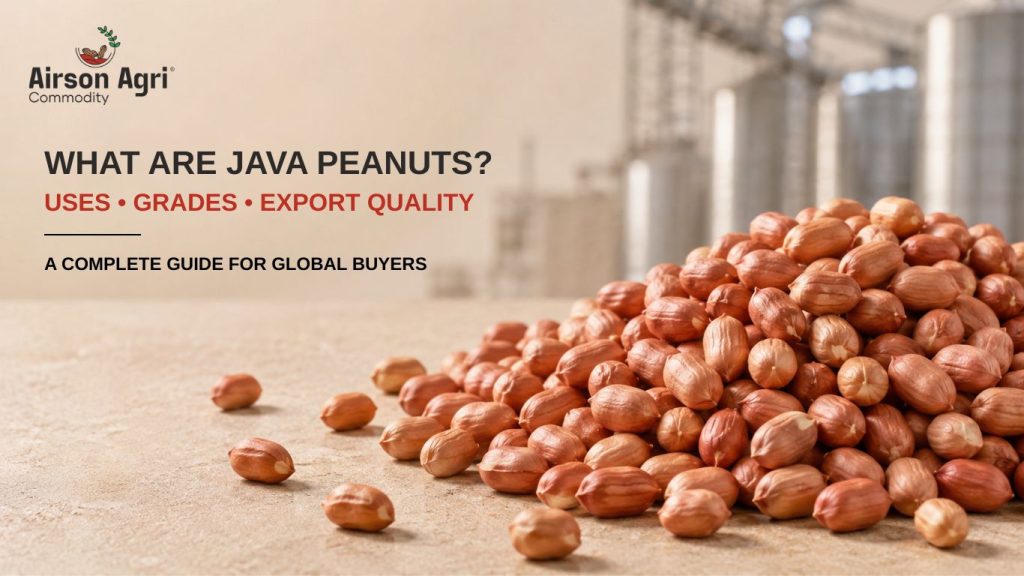
Java peanuts are a popular type of groundnut kernel used across India and global food markets. In India, Gujarat plays an important role in peanut sourcing and trade, especially across the Saurashtra region. Food manufacturers use Java peanuts for roasting, snacks, confectionery, peanut butter, food processing and oil extraction. As an Indian Java peanut supplier and exporter, Airson Agri supplies Java peanuts in multiple grades and specifications for domestic and international buyers.
What are Java peanuts?
Java peanuts are a type of groundnut kernel widely traded in India and international markets. Buyers commonly specify Java peanuts by count per ounce, such as 40/50, 50/60, 60/70 and 80/90. Food manufacturers use them for roasting, snacks, confectionery, peanut butter and other food applications. The right grade depends on the buyer’s required size, quality parameters and end use.
Java Peanuts Defination?
Java peanuts are an important type of groundnut traded in India and international markets. APEDA identifies Java or Spanish among India’s major groundnut varieties. Buyers and food manufacturers value Java peanuts for their versatile kernel size, taste and processing applications. They commonly use Java peanut kernels for roasting, snacks, confectionery, peanut butter and other food products. The trade also uses terms such as Java groundnut, Java groundnuts and Java mungfali for the same product category.
Java Peanuts vs Groundnuts: Are They the Same?
Yes, Java peanuts belong to the groundnut family. Peanut, groundnut and peanut kernel describe the same basic crop and its edible kernel, while Java peanut identifies a specific market variety or type. In India, buyers may use different trade names based on region, language, variety and market practice.
You may therefore see Java peanuts, Java peanut, Java groundnut, Java groundnuts, Java mungfali, peanut kernel and groundnut kernel across supplier catalogues and agricultural markets.
These terms do not always indicate different products. Instead, they often reflect how farmers, traders, processors and exporters describe the commodity. For international buyers, the more important details include the variety, count, kernel size, moisture, purity, oil content and required quality specifications.
India produces several groundnut varieties. APEDA lists Bold or Runner, Java or Spanish and Red Natal among the country’s groundnut varieties.
Are Java peanuts and groundnuts the same?
Java peanuts are a type of groundnut. The terms peanut and groundnut describe the crop, while Java peanut identifies a particular groundnut type commonly traded in India. Buyers should confirm the exact variety, grade and specifications before placing a bulk order.
Why Are Java Peanuts Popular in India?
Indian Java peanuts have strong importance in India’s food and agricultural trade. Gujarat plays a major role in India’s groundnut ecosystem. The state supports large-scale cultivation, processing and trade, particularly across the Saurashtra region.
Gujarat Agro Industries Corporation lists Junagadh, Rajkot, Amreli, Bhavnagar and Jamnagar, among other districts, as important groundnut-growing areas. It also identifies Rajkot and Junagadh as groundnut processing areas.
This established ecosystem creates advantages for the Java peanut trade. Farmers grow groundnuts at scale. Local markets connect growers with traders and processors. Processing facilities support cleaning, grading and value addition. Exporters then connect Indian supply with international food manufacturers and buyers.
Saurashtra also has a strong history in groundnut production and export. ICAR describes the region as a major groundnut-producing area and an important hub for groundnut exports and oil processing.
As a result, Java peanuts Gujarat has strong commercial relevance for buyers looking for Indian-origin groundnuts.
Where Are Java Peanuts Grown in India?
India grows groundnuts across several states, including Gujarat, Rajasthan, Madhya Pradesh, Tamil Nadu, Karnataka, Uttar Pradesh, Andhra Pradesh, Maharashtra, West Bengal and Telangana. Gujarat remains one of the country’s major groundnut-growing states.
Within Gujarat, the Saurashtra region has a particularly strong groundnut presence. Important sourcing and agricultural centres include Rajkot, Junagadh, Jamnagar, Amreli and Bhavnagar. Government sources also identify Kutch and Surendranagar among Gujarat’s groundnut-growing areas.
Rajkot has a significant groundnut and oilseed ecosystem. Junagadh has strong links with groundnut research, cultivation and processing. Jamnagar and Amreli also contribute to Gujarat’s groundnut production. Bhavnagar forms another important part of the state’s agricultural network.
Morbi also sits within the wider Saurashtra commercial network. For buyers searching for a Java peanut supplier in Morbi, Java peanuts in Rajkot or Java peanuts in Junagadh, the broader Gujarat sourcing ecosystem matters more than a single city.
For exporters, this regional network can connect agricultural production with cleaning, grading, processing, packaging and shipment. That connection helps buyers source Indian Java peanuts according to their required count and quality specifications.
Where are Java peanuts grown in India?
Java peanuts are grown in several Indian groundnut-producing regions, with Gujarat playing a major role. Within Gujarat, the Saurashtra region includes important groundnut centres such as Rajkot, Junagadh, Jamnagar, Amreli and Bhavnagar. Gujarat also has established groundnut processing and export infrastructure.
Java Peanuts from Gujarat: From Sourcing to Global Markets
Gujarat’s groundnut ecosystem supports more than cultivation. It also supports processing, grading, trading and export. This makes the region relevant to international buyers who need consistent specifications rather than simply raw agricultural supply.
For a buyer, location alone does not guarantee quality. The buyer should evaluate the Java peanut grade, count per ounce, moisture content, admixture, foreign material, oil content, aflatoxin requirements and packaging.
That is where an experienced Java peanut supplier and exporter can add value.
Airson Agri connects Indian agricultural sourcing with bulk buyers seeking Java peanuts for domestic and international applications. Its published Java peanut specifications include multiple count grades and buyer-specific quality parameters, giving buyers a clear starting point for technical discussions and quotations.
What Are Java Peanuts Used For?
Java peanuts serve a wide range of food and industrial applications. Food manufacturers use Java peanut kernels for roasting, snacks, confectionery, peanut butter and other processed foods. Peanut processors also use groundnuts for oil extraction and value-added ingredients such as peanut flour and protein products.
The right Java peanut grade depends on the final application. Buyers typically consider kernel size, count, moisture, quality, oil content and processing requirements before selecting a specification.
Java Peanuts for Roasting and Snacks
Roasting brings out the characteristic nutty flavour and aroma of peanuts. Therefore, Java peanuts work well for roasted and salted snacks, flavoured peanuts and mixed-nut products.
Snack manufacturers usually look for consistent kernel size, good appearance and suitable quality parameters. The right Java peanut size and grade can also help manufacturers achieve more consistent roasting and finished-product quality.
Java peanut kernels can support both retail snack production and large-scale food manufacturing. Manufacturers can then roast, season, coat or pack the kernels according to their product requirements.
Java Peanuts for Confectionery
The confectionery industry uses peanuts in products such as nut bars, chocolate products, pralines, candies and other nut-based formulations.
Java peanut kernels can provide the characteristic peanut flavour and texture that many confectionery products require. Manufacturers may use whole kernels, pieces or processed peanut ingredients depending on the recipe.
For bulk buyers, consistency matters. Therefore, buyers should specify the required Java peanut grade, kernel size, moisture and quality parameters before placing an order.
Java Peanuts for Peanut Butter
Peanuts form the primary raw material for peanut butter. Manufacturers roast and grind suitable peanut kernels to create a smooth or crunchy spread. Peanut processing can also produce peanut flour and other value-added ingredients.
For peanut butter production, manufacturers focus on factors such as flavour, kernel quality, oil content, roasting performance and consistency. The ideal specification can vary between processing facilities and finished products.
Therefore, a peanut butter manufacturer should discuss the required Java peanut grade and technical specifications with the supplier before sourcing in bulk.
Java Peanuts for Food Processing
Java peanuts support many food-processing applications beyond snacks and confectionery. Manufacturers can use peanuts in bakery products, nut mixes, protein-rich foods, spreads, sauces and other formulated products.
Processing also creates additional peanut ingredients. Manufacturers can convert peanuts into peanut flour, peanut protein, peanut butter and edible peanut oil, depending on the processing method.
This versatility makes Java peanut kernels valuable to food manufacturers that need a dependable bulk raw material.
Java Peanuts for Oil Extraction
Peanuts contain a substantial amount of oil, which makes them an important oilseed crop. Manufacturers can process groundnuts through pressing or extraction methods to produce peanut oil. Peanut processing can also generate peanut meal and other useful ingredients.
The intended end use affects the required raw-material specification. Oil processors therefore evaluate factors such as oil content, kernel quality, moisture and other quality parameters before purchasing bulk Java peanuts.
Java Peanut Kernels for Bulk Food Manufacturing
For large food manufacturers, Java peanut kernels offer flexibility. One raw material can support several product categories, from roasted snacks and confectionery to peanut butter and processed peanut ingredients.
However, bulk buyers should not select a Java peanut grade based on size alone. They should match the specification with their processing requirements.
Before purchasing, buyers should confirm:
Required Java peanut count and grade
Kernel size and appearance
Moisture specification
Admixture and foreign material limits
Oil content
Aflatoxin requirements
Packing format
Order quantity
Destination-country requirements
Airson Agri supplies Java peanuts in multiple count grades and publishes product specifications for commercial buyers. Its listed Java peanut applications can support buyers looking for suitable raw material for food processing and export-oriented requirements.
What are Java peanuts used for?
Java peanuts support roasting, snacking, confectionery, peanut butter, food processing and oil extraction. Buyers should select the grade according to kernel size, quality specifications, processing requirements and the final application.
What Are the Benefits of Java Peanuts?
Java peanuts offer nutritional value as well as strong food-processing versatility. Like other peanuts, Java peanuts provide protein, unsaturated fats, dietary fibre and several vitamins and minerals. Their nutritional profile makes them useful in snacks, spreads and other food products.
However, the exact nutritional composition can vary with the peanut variety, growing conditions, processing method and preparation. Therefore, buyers and consumers should consider the specific product and preparation method when evaluating nutritional value.
Java Peanuts Nutrition
Java peanuts contain a combination of protein, fats, carbohydrates and dietary fibre. They also provide nutrients such as magnesium, phosphorus, niacin, vitamin E and other micronutrients. USDA FoodData Central lists peanuts as a nutrient-dense food that provides protein, unsaturated fats, fibre and several essential micronutrients.
Roasting, grinding, blanching and other processing methods can affect the final nutritional composition. Added salt, sugar or other ingredients can also change the nutritional profile of a finished peanut product.
For this reason, consumers should check the nutrition label of the final product rather than assume that every Java peanut product has exactly the same nutritional values.
Java Peanuts Protein Content
Protein represents one of the key nutritional components of peanuts. This makes Java peanut kernels useful in many foods where manufacturers want to add a naturally protein-containing ingredient.
The protein content can vary according to variety, growing conditions and processing. Manufacturers may also use peanut-derived ingredients such as peanut flour and peanut protein in formulated foods.
For bulk buyers, however, protein should not be the only purchasing criterion. The intended application may require a particular kernel size, moisture level, oil content, aflatoxin specification and other quality parameters.
Healthy Fats and Other Nutrients
Peanuts contain predominantly unsaturated fatty acids, along with protein and dietary fibre. They also provide micronutrients such as vitamin E, magnesium and phosphorus. These nutritional characteristics contribute to the popularity of peanuts as both a snack ingredient and a food-processing raw material.
Java peanuts also contain naturally occurring peanut oil. Airson Agri lists an oil content of 42–48% for its Java peanut specification, subject to the applicable product requirements.
Preparation matters. Raw, roasted, salted and processed peanut products can have different nutritional profiles. Therefore, buyers should evaluate the specification of the actual product they plan to purchase.
Why Food Manufacturers Value Java Peanuts
Food manufacturers value Java peanuts because they combine nutritional composition with processing flexibility.
Manufacturers can use Java peanut kernels in:
Roasted and flavoured snacks
Peanut butter
Confectionery
Bakery products
Nut mixes
Protein-focused food products
Peanut flour and other ingredients
Edible peanut oil
The variety of applications allows manufacturers to select different kernel grades according to their production requirements.
For commercial buyers, consistency also matters. A suitable specification can help manufacturers maintain predictable processing performance and finished-product quality. Therefore, buyers should evaluate Java peanut grades, count, moisture, oil content, foreign material, admixture and aflatoxin requirements before purchasing.
Are Java peanuts healthy?
Java peanuts can contribute protein, unsaturated fats, fibre and several micronutrients to the diet. Their nutritional composition makes peanuts useful in snacks and other food products. However, the exact nutritional profile can vary by variety, processing method and preparation.
For food manufacturers, the value goes beyond nutrition. Java peanut kernels can serve as a versatile raw material across multiple product categories. The next step for buyers is understanding how Java peanut grades and count sizes determine the right specification for each application.
Java Peanut Grades and Sizes Explained
Java peanuts come in different kernel sizes and count grades. Buyers use these grades to specify the approximate number of kernels found in one ounce. This system helps food manufacturers, traders and exporters select a Java peanut specification that fits their application.
Airson Agri lists Java peanut grades including 40/50, 45/55, 50/60, 60/70, 70/80, 80/90, 100/120, 120/140, 140/160 and 160/180. Availability and final specifications can depend on buyer requirements.
What Does Count Per Ounce Mean?
Count per ounce refers to the approximate number of peanut kernels in one ounce by weight.
For example, a 50/60 Java peanut grade indicates approximately 50 to 60 kernels per ounce. A 70/80 grade indicates approximately 70 to 80 kernels per ounce.
This grading system helps buyers communicate their preferred kernel size when sourcing Java peanuts in bulk. Instead of relying only on descriptions such as “large” or “small,” buyers can specify a measurable count range.
The count also helps exporters and food manufacturers match raw materials with their production requirements.
Does a Lower Count Mean Bigger Peanuts?
Generally, yes.
A lower count per ounce means larger kernels, while a higher count per ounce means smaller kernels.
For example, 40/50 represents a larger-kernel grade than 80/90. Similarly, 50/60 represents larger kernels than 100/120.
However, buyers should not select a grade based on count alone. They should also review moisture, admixture, foreign material, oil content, aflatoxin requirements and other quality specifications.
Java Peanut Size Chart
| Java Peanut Grade | Approx. Count Per Ounce | General Kernel Size |
|---|---|---|
| 40/50 | 40–50 | Larger kernels |
| 45/55 | 45–55 | Large kernels |
| 50/60 | 50–60 | Medium-large kernels |
| 60/70 | 60–70 | Medium kernels |
| 70/80 | 70–80 | Smaller kernels |
| 80/90 | 80–90 | Smaller kernels |
| 100/120 | 100–120 | Fine/smaller kernels |
| 120/140 | 120–140 | Fine/smaller kernels |
| 140/160 | 140–160 | Fine/smaller kernels |
| 160/180 | 160–180 | Fine/smaller kernels |
These grades reflect the count ranges published on Airson Agri’s Java peanut product page. Buyers should confirm the exact commercial specification before placing an order.
What Does 40/50 Mean in Java Peanuts?
40/50 Java peanuts represent a larger-kernel count range of approximately 40 to 50 kernels per ounce. The lower count generally indicates a larger kernel size compared with higher-count grades.
What Does 50/60 Mean in Java Peanuts?
50/60 Java peanuts represent approximately 50 to 60 kernels per ounce. This grade sits between larger-count grades such as 40/50 and smaller-count grades such as 70/80.
What Does 60/70 Mean in Java Peanuts?
60/70 Java peanuts represent approximately 60 to 70 kernels per ounce. Buyers can select this grade when their application requires a medium kernel size within the specified quality parameters.
What Does 70/80 Mean in Java Peanuts?
70/80 Java peanuts represent approximately 70 to 80 kernels per ounce. The higher count generally indicates smaller kernels than 40/50, 45/55, 50/60 or 60/70 grades.
What Does 80/90 Mean in Java Peanuts?
80/90 Java peanuts represent approximately 80 to 90 kernels per ounce. This count generally indicates smaller kernels compared with the lower-count Java peanut grades.
What does 50/60 mean in Java peanuts?
50/60 refers to a count-per-ounce grade. It indicates approximately 50 to 60 peanut kernels per ounce. In general, a lower count indicates larger kernels, while a higher count indicates smaller kernels. Buyers should confirm the exact grade and specification with their supplier before purchase.
Which Java Peanut Grade Should You Choose?
The best Java peanut grade depends on the intended application.
A snack manufacturer may prioritize kernel appearance and size. A confectionery manufacturer may require a specific kernel size for its recipe. A peanut butter manufacturer may focus more heavily on processing performance, flavour, oil content and other technical requirements.
Therefore, there is no single “best Java peanut grade” for every buyer.
For bulk sourcing, buyers should provide their required count, quantity, application, moisture specification, quality parameters, packing requirement and destination. An experienced Java peanut supplier can then recommend a suitable specification.
Airson Agri supplies Java peanuts across multiple count ranges and publishes technical specifications to help commercial buyers identify the right product for their requirements.
Java Peanuts vs Bold Peanuts vs TJ Peanuts
Buyers often compare Java peanuts, Bold peanuts and TJ peanuts when sourcing Indian groundnuts. Each type can serve different food-processing and trading requirements. However, no single variety works best for every application.
The right choice depends on kernel characteristics, count, grade, processing requirements, quality specifications, end use and buyer preference.
Java Peanuts vs Bold Peanuts
Java peanuts and Bold peanuts represent different groundnut types commonly traded in India. Buyers often distinguish them by kernel characteristics, size and intended application.
Java peanuts commonly appear in multiple count grades, including 40/50, 45/55, 50/60, 60/70, 70/80 and 80/90, along with finer count ranges. Airson Agri publishes these Java peanut specifications for commercial buyers.
Bold peanuts, also known as Runner-type peanuts in many Indian trade contexts, generally serve applications where buyers require specific kernel characteristics and grades. APEDA lists Bold or Runner and Java or Spanish among India’s major groundnut varieties.
The choice therefore depends on the buyer’s required specification rather than a simple “Java versus Bold” ranking.
Java Peanuts vs TJ Peanuts
Java peanuts and TJ peanuts can also appear together in Indian peanut trade discussions. Buyers may compare them based on kernel size, appearance, grade availability, application and commercial requirements.
However, trade terminology can vary between suppliers and markets. Therefore, an international buyer should not rely only on a variety name such as “TJ.”
Instead, the buyer should request a clear product specification covering:
Variety or type
Count and kernel size
Moisture
Admixture
Foreign material
Oil content
Aflatoxin requirements
Packing
Quantity
Destination requirements
This approach reduces confusion and helps buyers compare products on measurable specifications.
Java Peanuts vs Bold Peanuts vs TJ Peanuts: Comparison
| Factor | Java Peanuts | Bold Peanuts | TJ Peanuts |
|---|---|---|---|
| Kernel characteristics | Commonly traded in multiple count grades; buyers select size according to application | Commonly associated with Bold/Runner-type groundnuts and specified kernel characteristics | Trade terminology can vary; buyers should confirm the exact product specification |
| Typical grades | 40/50, 45/55, 50/60, 60/70, 70/80, 80/90 and finer counts | Grades vary according to supplier, market and specification | Grades vary according to supplier and market |
| Common applications | Roasting, snacks, confectionery, peanut butter and food processing | Snacks, food processing, roasting and other peanut applications | Application depends on the exact variety and buyer specification |
| Buyer requirements | Count, moisture, oil content, aflatoxin, purity, packing and end use | Size, quality, moisture, purity, aflatoxin and end use | Product identity, grade, quality parameters, moisture, purity and end use |
APEDA identifies Java or Spanish and Bold or Runner as major Indian groundnut varieties. Airson Agri’s published Java peanut specifications provide multiple count options for commercial sourcing.
Which Java Peanut Variety Should Buyers Choose?
There is no universal answer to “Which is better, Java or Bold?” or “Which peanut variety is best?”
The right product depends on the final application.
A snack manufacturer may prioritize kernel size, appearance and roasting performance. A confectionery manufacturer may need a specific size and texture. A peanut butter processor may prioritize flavour, oil content and processing performance. An exporter may need to meet strict destination-country requirements for moisture, aflatoxin, foreign material and other quality parameters.
Therefore, buyers should start with their application and technical requirements. They should then compare available grades and suppliers.
For example, a buyer can provide:
Required variety → Count/grade → Quantity → Moisture → Quality requirements → Packing → Destination
The supplier can then offer the closest specification.
What Should Buyers Check Before Choosing a Peanut Supplier?
Variety alone should never determine a bulk purchase. Buyers should also evaluate:
Product specification — Does the supplier clearly define the grade?
Count and size — Does the offered grade match the required application?
Quality parameters — Does the product meet the agreed limits?
Food-safety requirements — Can the supplier meet applicable aflatoxin requirements?
Packaging — Does the packing suit storage and international transportation?
Quantity — Can the supplier support the required volume?
Destination requirements — Does the specification meet the import market’s requirements?
Documentation — Can the supplier provide the required commercial and shipping documents?
Airson Agri focuses on specification-based Java peanut sourcing. Its published product information includes multiple count grades, moisture requirements, admixture, foreign material, oil content, aflatoxin requirements and export-oriented packing options.
Java vs Bold vs TJ: Which is better?
There is no single best peanut type for every buyer. The right choice depends on the required kernel size, grade, application, quality parameters, processing requirements and destination-market specifications. Buyers should compare products using measurable specifications rather than variety names alone.
What Makes Export-Quality Java Peanuts?
Export-quality Java peanuts need more than good appearance. International buyers look for a clear and consistent specification that matches their application and destination market. Key factors include count, moisture, admixture, foreign material, oil content, aflatoxin, kernel quality and packaging.
For Indian peanut exports, the requirements can also vary by destination. APEDA’s current export procedures require exporters to meet the aflatoxin and quality parameters of the importing country. The process also includes testing and export documentation for applicable consignments.
For this reason, a reliable Java peanut exporter should define the product specification clearly before shipment.
Java Peanut Quality Parameters
A buyer should review the following parameters before purchasing export-quality Java peanuts:
| Quality Parameter | Why It Matters |
|---|---|
| Count / Grade | Defines the approximate kernel size |
| Moisture | Supports quality and proper storage |
| Admixture | Indicates the level of unwanted material mixed with the product |
| Foreign Material | Helps assess product cleanliness |
| Oil Content | Important for food and oil-processing applications |
| Aflatoxin | Critical food-safety parameter for export markets |
| Kernel Quality | Covers appearance, integrity and suitability for processing |
| Packaging | Protects the product during storage and transportation |
Airson Agri publishes specific Java peanut parameters, including multiple count grades, moisture, admixture, foreign material, oil content, aflatoxin and packing options.
Java Peanut Moisture Content
Moisture content plays an important role in peanut quality and storage. Excess moisture can create conditions that support mould growth and quality deterioration.
Airson Agri lists 7% maximum or 8% maximum moisture, according to customer requirements.
APEDA’s current export procedure states that harvested peanuts should be dried to minimize damage and bring moisture below the level that supports mould growth, generally below 8%.
However, buyers should not treat one moisture figure as a universal export rule. The required specification can depend on the destination, product category and contractual requirements.
Java Peanut Oil Content
Peanuts naturally contain oil, which makes oil content an important specification for several food and processing applications.
Airson Agri lists 42–48% oil content for its Java peanut specification.
Oil content can matter particularly to buyers who source Java peanuts for peanut butter, food processing or oil extraction. However, the buyer should specify the required parameter before confirming an order.
A supplier should also provide the agreed specification clearly so both parties can evaluate the product against the same criteria.
Java Peanut Aflatoxin Requirements
Aflatoxin represents one of the most important food-safety considerations in peanut exports. Certain moulds can produce aflatoxins, so exporters and buyers must control contamination throughout sourcing, drying, storage, processing and shipment.
APEDA operates a dedicated system for controlling aflatoxin in Indian peanut exports. The system includes sourcing records, laboratory testing and export certification.
Importantly, aflatoxin limits differ between destination markets and product categories. APEDA’s published export procedures show different maximum levels for markets and applications, including the EU, Japan, Korea and other destinations.
Therefore, buyers should never rely on a generic “global aflatoxin limit.” Instead, they should confirm the current requirement for their destination country and product category.
Airson Agri lists aflatoxin negative and 5 PPB by TLC method as per customer requirement in its Java peanut specification.
What is the aflatoxin limit for Java peanuts?
There is no single limit that applies to every export destination. Aflatoxin requirements vary by country, product category and intended use. Buyers should confirm the applicable destination-market requirement before shipment and request the appropriate test documentation.
Java Peanut Admixture and Foreign Material
Admixture and foreign material help buyers evaluate product cleanliness and purity.
Airson Agri lists:
Admixture: 1% maximum or 0% maximum, according to customer requirements
Foreign material: 0.50% maximum or 0% maximum, according to customer requirements
These parameters matter because food manufacturers need raw materials that meet their processing specifications. Export buyers should therefore define acceptable limits before confirming the purchase.
A clear specification also helps the buyer and supplier avoid misunderstandings during inspection and shipment.
How Are Java Peanuts Cleaned, Sorted and Graded?
Java peanut preparation starts with proper sourcing and post-harvest handling. Export-oriented processing can include cleaning, shelling, sorting, grading and packing.
The objective is simple: deliver a consistent product that meets the agreed specification.
During grading, processors can separate kernels according to size and count. Cleaning helps remove unwanted material. Sorting helps improve consistency and remove unsuitable kernels. Quality checks then verify parameters such as moisture and food-safety requirements.
APEDA’s current export procedure covers peanut shelling, grading, processing and storage units and requires applicable units involved in export supply chains to follow the prescribed registration and compliance framework.
For international buyers, the process does not end with grading. Packaging also matters.
Airson Agri offers Java peanuts in new jute bags in several pack sizes and also offers vacuum packing with an outer PP woven bag in 25 kg gross packing. Its published specification states that one 20-foot FCL can load approximately 19 MT or 400 bags of 50 kg each.
What Should Buyers Check Before Ordering Export-Quality Java Peanuts?
A practical buyer checklist includes:
Java peanut grade → count → moisture → admixture → foreign material → oil content → aflatoxin requirement → packaging → quantity → destination-country requirements.
This approach gives buyers a measurable basis for comparing suppliers.
For example, a buyer looking for Java peanuts in bulk from India should provide the required count, quantity, packing and destination. The exporter can then match the order with the appropriate technical specification.
Airson Agri provides published Java peanut specifications and supports buyers looking for Java peanut supply from India, including multiple count grades and export-oriented packing options.
What makes Java peanuts export quality?
Export-quality Java peanuts meet the buyer’s agreed requirements for count, moisture, purity, foreign material, oil content, aflatoxin, kernel quality and packaging. The product must also comply with the applicable requirements of the destination market.
Airson Agri Java Peanuts: Quality Built for Global Buyers
For international buyers, choosing a Java peanut supplier involves more than comparing prices. Buyers need a clear product specification, consistent quality parameters, suitable packaging and a supplier who understands bulk and export requirements.
Airson Agri provides Java peanuts from India in multiple kernel-count grades and publishes technical specifications for commercial buyers. This gives importers, food manufacturers, traders and distributors a clear basis for evaluating the product before placing an order.
Airson Agri Java Peanut Specifications
Airson Agri offers Java peanuts across a broad range of kernel-count specifications. Buyers can select the required grade according to their application and purchasing requirements.
| Specification | Airson Agri Java Peanuts |
|---|---|
| Java Peanut Counts | 40/50, 45/55, 50/60, 60/70, 70/80, 80/90, 100/120, 120/140, 140/160, 160/180 |
| Moisture | 7% or 8% maximum, according to customer requirements |
| Admixture | 1% or 0% maximum, according to customer requirements |
| Foreign Material | 0.50% or 0% maximum, according to customer requirements |
| Oil Content | 42–48% |
| Aflatoxin | Negative / 5 PPB by TLC method, as per customer requirement |
| Packing | Jute bags; vacuum packing with PP woven outer bag |
| Container Loading | Approximately 19 MT / 400 × 50 kg bags per 20′ FCL |
These specifications come from Airson Agri’s published Java peanut product information. Final specifications should always be confirmed with Airson Agri before an order, because requirements can vary according to the buyer, destination and application. (airsonagri.com)
The broad count range gives buyers flexibility. A buyer looking for larger kernels can discuss grades such as 40/50 or 45/55, while buyers requiring smaller kernels can consider higher-count specifications such as 100/120, 120/140, 140/160 or 160/180.
The same principle applies to quality parameters. Instead of offering one fixed specification to every buyer, Airson Agri’s published data includes customer-specific limits for moisture, admixture and foreign material.
Why Choose Airson Agri for Java Peanuts?
A reliable Java peanut supplier should make it easy for buyers to understand what they are purchasing, which specification applies and how the product will be packed for shipment.
Airson Agri brings together several factors relevant to commercial Java peanut sourcing:
Indian sourcing: Airson Agri supplies Java peanuts from India, connecting buyers with India’s established groundnut supply network.
Gujarat connection: Gujarat has a major groundnut ecosystem, particularly across Saurashtra. This gives buyers access to a region with established cultivation, processing and trading activity.
Multiple Java peanut grades: Airson Agri publishes ten count ranges, from 40/50 through 160/180, allowing buyers to specify kernel size according to their application.
Defined quality parameters: Buyers can discuss measurable requirements for moisture, admixture, foreign material, oil content and aflatoxin instead of relying only on general product descriptions.
Bulk supply: The published packing information includes approximately 19 MT per 20′ FCL, with around 400 bags of 50 kg each, subject to the final shipment configuration.
Export-oriented packing: Airson Agri lists jute bags as well as vacuum packing with an outer PP woven bag, giving buyers options based on their handling and transportation requirements.
Buyer-specific specifications: Not every international buyer needs the same specification. Airson Agri’s published product information allows parameters such as moisture, admixture, foreign material and aflatoxin to be discussed according to customer requirements. (airsonagri.com)
A Practical Way to Buy Java Peanuts from India
Before requesting a quotation, international buyers can prepare a simple specification:
Java peanut grade + quantity + moisture requirement + quality requirements + packing + destination port.
For example:
50/60 Java Peanuts | 19 MT | 7% max moisture | specified aflatoxin requirement | vacuum packing | destination port
This gives the supplier enough information to prepare a more relevant commercial offer.
For buyers who need a different grade, the same process applies. Airson Agri’s published Java peanut range covers 40/50, 45/55, 50/60, 60/70, 70/80, 80/90, 100/120, 120/140, 140/160 and 160/180. (airsonagri.com)
Looking for Java peanuts from India?
Share your required grade, quantity, quality specification, packing and destination with Airson Agri. The team can discuss the appropriate Java peanut specification for your application and export requirement.
Java Peanuts from Gujarat: India’s Major Sourcing Region
Gujarat holds an important position in India’s groundnut industry and has a well-established network for groundnut cultivation, processing, trading and export. The state’s Saurashtra region plays a particularly important role in groundnut production and commercial activity.
For international buyers searching for Java peanuts Gujarat, the advantage goes beyond finding a supplier in one city. Gujarat offers an interconnected agricultural and processing ecosystem that can connect farm-level production with cleaning, grading, packaging and export.
Government sources identify Gujarat as one of India’s major groundnut-producing states. Gujarat Agro Industries Corporation also identifies several districts across the state as important groundnut-growing areas.
Java Peanuts Gujarat
Java peanuts in Gujarat benefit from the state’s established groundnut ecosystem. Farmers, traders, processors and exporters operate across multiple agricultural and commercial centres.
This network supports several stages of the supply chain:
Cultivation → collection → processing → cleaning → grading → quality control → packing → domestic supply or export
For buyers, this integrated ecosystem can make Gujarat an important sourcing region for Indian Java peanuts, Java peanut kernels and other groundnut products.
However, buyers should evaluate the supplier’s actual product specifications rather than assume that every Java peanut from Gujarat has the same quality.
Java Peanuts Saurashtra
Saurashtra forms one of the most important groundnut-producing regions of Gujarat. The region has a long-standing connection with groundnut cultivation, processing and trade.
ICAR describes Saurashtra as a major groundnut-producing region and highlights its importance in India’s groundnut export and oil-processing ecosystem.
This regional concentration creates a strong commercial network for buyers looking for Java peanuts from Gujarat.
Saurashtra also connects several important agricultural and trading centres, including Rajkot, Junagadh, Jamnagar, Amreli and Bhavnagar.
Java Peanuts Rajkot
Rajkot has an established connection with Gujarat’s groundnut industry. Gujarat Agro Industries Corporation identifies Rajkot among the state’s groundnut-growing areas and lists it as a groundnut processing area.
That makes Rajkot relevant to buyers searching for Java peanuts Rajkot, Java peanut supplier Rajkot, Java peanut wholesaler Rajkot and related groundnut supply terms.
For commercial buyers, however, the city name should only be the starting point. The buyer should confirm the actual Java peanut grade, count, moisture, quality parameters, packing and quantity before placing an order.
Java Peanuts Junagadh
Junagadh has strong agricultural and research links with groundnut production. The district also forms part of Gujarat’s wider groundnut processing and trading ecosystem.
Gujarat Agro Industries Corporation lists Junagadh among Gujarat’s groundnut-growing areas and identifies it as a groundnut processing area.
Therefore, searches such as Java peanuts Junagadh, Java peanut supplier Junagadh and Java groundnut supplier Junagadh reflect a commercially relevant sourcing region rather than an isolated location keyword.
Java Peanuts Morbi
Morbi is an important commercial centre within the wider Saurashtra region. Its location connects it with surrounding agricultural and trading markets.
For buyers searching for Java peanuts Morbi, Java peanut supplier Morbi, Java peanut wholesaler Morbi or Java peanut wholesale Morbi, the wider Saurashtra supply network provides useful context.
However, Morbi should not be presented as Gujarat’s primary Java peanut-growing district without supporting evidence. A more accurate approach is to position Morbi within the region’s broader trade, sourcing and distribution network.
Java Peanuts Jamnagar
Jamnagar is another important groundnut-growing area identified by Gujarat Agro Industries Corporation. Its agricultural activity contributes to Gujarat’s wider groundnut supply network.
For buyers, Jamnagar is therefore relevant when researching Java peanuts Jamnagar, Java peanut supplier Jamnagar and broader Gujarat groundnut sourcing.
As with other locations, the actual purchase decision should depend on product specifications rather than location alone.
Java Peanut Supplier Gujarat
When searching for a Java peanut supplier in Gujarat, buyers should look beyond a simple supplier listing.
A reliable sourcing process should confirm:
Java peanut variety
Count and grade
Moisture specification
Admixture
Foreign material
Oil content
Aflatoxin requirement
Packaging
Quantity available
Export documentation
Destination-country requirements
This approach helps international buyers compare suppliers on measurable parameters.
Airson Agri supplies Java peanuts from India and publishes multiple Java peanut count grades, along with specifications for moisture, admixture, foreign material, oil content, aflatoxin and packaging.
Java Peanut Exporter Gujarat
Gujarat’s agricultural and processing ecosystem also supports its role in India’s groundnut export trade.
For a buyer searching for a Java peanut exporter from Gujarat, the important question is not simply where the supplier operates. The buyer should ask whether the supplier can provide the required grade, quality specification, packing, quantity and export documentation for the destination market.
Airson Agri’s Java peanut offering includes multiple count grades from 40/50 through 160/180, along with buyer-specific quality parameters and export-oriented packing options.
Why Gujarat Matters to Global Java Peanut Buyers
Gujarat’s advantage comes from the strength of its wider supply chain.
Agricultural production provides the raw material.
Regional markets connect farmers and traders.
Processing facilities support cleaning, grading and preparation.
Exporters connect the finished product with international buyers.
This makes Gujarat an important sourcing base for businesses looking for Indian Java peanuts, Java peanut kernels, bulk groundnuts and export-ready peanut products.
For global buyers, however, location should always work together with product verification. Before confirming an order, request the exact Java peanut grade, technical specification, quality parameters, packing details and shipment information.
Why is Gujarat important for Java peanuts?
Gujarat has a well-established groundnut ecosystem covering cultivation, processing, trading and export. The Saurashtra region, including important centres such as Rajkot and Junagadh, plays a significant role in this network. This makes Gujarat an important sourcing region for buyers looking for Indian Java peanuts.
Java Peanut Price in India
The Java peanut price in India does not stay fixed. Buyers may see different prices for different grades, qualities and quantities, even within the same market period.
For bulk purchases, the quoted price depends on the exact product specification and commercial terms. Therefore, buyers looking for Java peanuts price per kg, Java peanuts wholesale price or Java peanut price in India should provide their requirements before comparing quotations.
What Determines Java Peanut Price Per Kg?
Several factors influence the final Java peanut price per kg.
Grade: Different Java peanut grades can command different prices. A buyer may request 40/50, 50/60, 60/70, 80/90 or another count based on the application.
Count: Count per ounce indicates the approximate kernel size. Lower-count grades generally contain larger kernels, while higher-count grades contain smaller kernels. Demand for a particular size can affect its market value.
Quality: Kernel appearance, purity, moisture, admixture, foreign material and other quality parameters can influence the quotation.
Crop availability: Seasonal crop availability can affect supply and pricing. Market conditions can change as new crop arrivals enter the supply chain.
Moisture: Buyers requiring a specific moisture level may receive a quotation based on that specification.
Aflatoxin requirements: Export orders may require specific aflatoxin limits and testing procedures. Destination-market requirements can therefore affect the final cost.
Processing: Cleaning, sorting, grading and other processing steps add value and can influence the final price.
Packaging: Jute bags, vacuum packing and other packaging formats can have different costs.
Order quantity: Bulk orders can have different commercial terms from smaller quantities.
Destination: Domestic delivery and international export orders involve different logistics and documentation requirements.
Freight: For export shipments, freight and other transportation costs can affect the landed cost.
Current market conditions: Agricultural commodity prices can move with supply, demand, crop expectations, currency movements and other market factors.
Therefore, a single number cannot accurately represent the Java peanut wholesale price for every buyer.
Why Does Java Peanut Wholesale Price Change?
Java peanut wholesale prices change because the underlying commodity market changes.
Supply can increase during crop arrivals and tighten during periods of lower availability. Demand can also change based on domestic consumption, food-processing requirements and international orders.
Grade creates another major difference. A buyer looking for 40/50 Java peanuts may receive a different quotation from a buyer requesting 100/120 Java peanuts because kernel size and market demand differ.
Quality requirements can also change the price. For example, an export buyer may require specific limits for moisture, aflatoxin, admixture and foreign material, along with particular packaging and documentation.
That is why buyers should compare quotations using the same specification.
A useful comparison looks like:
Same grade + same quantity + same quality parameters + same packing + same delivery terms
Only then can a buyer make a meaningful price comparison between Java peanut suppliers.
Java Peanuts Price in Gujarat
Buyers searching for Java peanuts price Gujarat, Java peanut supplier Gujarat or Java peanut wholesale Gujarat should also consider the commercial terms behind the quoted price.
Gujarat has an established groundnut cultivation, processing and trading ecosystem. However, the supplier’s location does not automatically determine the final price.
The quotation can also depend on:
Available Java peanut grade
Current stock
Processing requirements
Quantity
Packing
Loading location
Transport
Export requirements
Destination
Therefore, buyers should request a current quotation instead of relying on an old market price displayed online.
How to Get a Current Java Peanut Export Quote?
Getting an accurate Java peanut export quote is straightforward when the buyer provides the right information.
Send the supplier:
1. Java peanut grade: For example, 40/50, 50/60 or 60/70
2. Quantity: Required MT or number of bags
3. Quality: Moisture, aflatoxin and other specifications
4. Packing: Jute, vacuum or another required format
5. Destination: Country and preferably destination port
6. Application: Roasting, snacks, confectionery, peanut butter or other use
7. Required delivery terms: If applicable
Airson Agri can then evaluate the requirement and provide a quotation based on the requested specification and shipment details.
For example:
50/60 Java Peanuts | 19 MT | 7% Max Moisture | Required Aflatoxin Specification | Vacuum Packing | Destination Port
This provides much more useful information than simply asking, “What is the Java peanut price per kg?”
What is the Java peanut price in India?
Java peanut prices vary by grade, quality, quantity, packaging, market conditions and destination. Therefore, buyers should request a current quotation based on their exact specification instead of relying on a generic per-kg price.
Request a Java Peanut Price from Airson Agri
If you are sourcing Java peanuts in bulk from India, provide your required grade, quantity, quality parameters, packing and destination.
Airson Agri can discuss the appropriate Java peanut specification and commercial quotation based on your requirements.
Grade + Quantity + Quality + Packing + Destination = A more accurate Java peanut quotation.
How to Buy Java Peanuts in Bulk from India
Buying Java peanuts in bulk from India requires more than finding the lowest quotation. Importers need to confirm the product grade, quality parameters, packing, quantity, shipment terms and destination-market requirements before placing an order.
India has an established groundnut export industry, while Gujarat provides an important sourcing and processing base. For a Java peanut importer, the best approach is to define the product specification first and then compare qualified suppliers on the same requirements.
What Should Buyers Ask a Java Peanut Supplier?
Before ordering bulk Java peanuts, buyers should ask the supplier for a clear product specification.
Important questions include:
Which Java peanut grade is available?
What is the count per ounce?
What moisture specification applies?
What are the admixture and foreign-material limits?
What is the oil content?
What aflatoxin specification can the supplier meet?
What packing options are available?
How much product can the supplier supply?
What is the minimum order quantity?
What quality or inspection documents are available?
What are the shipment and delivery terms?
Can the supplier provide a sample before the bulk order?
A clear specification helps buyers compare suppliers fairly. It also reduces the risk of receiving a product that does not match the intended application.
How to Choose a Reliable Java Peanut Exporter
A reliable Java peanut exporter from India should provide more than a product name and price.
Buyers should look for:
Clear specifications: The exporter should explain the grade, count and quality parameters.
Product transparency: The buyer should know exactly what specification the quotation covers.
Export capability: The supplier should understand international shipment requirements and destination-market conditions.
Suitable packaging: The exporter should offer packing appropriate for storage, handling and transportation.
Quality documentation: Buyers should discuss applicable laboratory reports, inspection documents and certificates before shipment.
Communication: A responsive supplier can help resolve specification, documentation and logistics questions before the order moves forward.
Airson Agri publishes Java peanut grades and technical specifications, including count, moisture, admixture, foreign material, oil content, aflatoxin and packing information. This gives buyers a specification-based starting point for a commercial discussion. (airsonagri.com)
What Specifications Should Importers Confirm?
A Java peanut buyer should confirm the complete product specification before approving the order.
At minimum, discuss:
| Specification | What the Buyer Should Confirm |
|---|---|
| Variety | Java / Spanish or required specification |
| Count | Required grade such as 40/50, 50/60 or 60/70 |
| Moisture | Maximum permitted level |
| Admixture | Maximum permitted level |
| Foreign Material | Maximum permitted level |
| Oil Content | Required specification, where applicable |
| Aflatoxin | Destination-market requirement |
| Kernel Quality | Appearance and processing suitability |
| Packing | Jute, vacuum or other agreed format |
| Quantity | Required MT or bags |
| Destination | Country and port |
| Inspection | Agreed inspection/testing requirements |
This specification should appear clearly in the quotation or commercial documentation so both parties work from the same requirements.
How Are Java Peanuts Packed for Export?
Packaging protects Java peanuts during handling, storage and transportation.
The right packing depends on the buyer’s requirements, shipment method and destination. Export buyers should confirm the bag type, net weight, outer packaging, loading configuration and any destination-specific packaging requirements before shipment.
Airson Agri lists new jute bags as well as vacuum packing with an outer PP woven bag for its Java peanuts. Its published information also states approximately 19 MT or 400 × 50 kg bags per 20′ FCL, subject to the final shipment configuration. (airsonagri.com)
For long-distance shipments, buyers should also discuss storage and transportation conditions with the exporter to help maintain product quality throughout the supply chain.
How Are Java Peanuts Exported from India?
The export process generally begins with a buyer specification and supplier quotation.
A typical transaction follows this sequence:
Buyer requirement → Product specification → Supplier quotation → Sample/approval → Order confirmation → Processing and quality checks → Packing → Documentation → Shipment
For regulated agricultural exports, exporters must also comply with applicable Indian export procedures and the requirements of the destination market.
APEDA’s peanut export procedures include requirements related to registered processing units, traceability, laboratory testing and aflatoxin control for applicable export consignments. (apeda.gov.in)
The exact process can differ according to the destination country, product specification and shipment terms.
What Documents Do Buyers Need?
The exact documentation depends on the destination country, buyer requirements, shipment terms and applicable regulations.
Depending on the transaction, buyers and exporters may need documents such as:
Commercial invoice
Packing list
Certificate of origin
Bill of lading
Phytosanitary certificate, where applicable
Certificate of analysis or laboratory report, where required
Fumigation or treatment documentation, where applicable
Export-related certificates or declarations required by the destination
Other documents requested by the importer or authorities
Importers should confirm the current requirements with the relevant authorities, customs professionals or their logistics partner before shipment.
For peanuts, food-safety documentation can be particularly important. APEDA’s export procedures include specific requirements for aflatoxin testing and certification for applicable markets. (apeda.gov.in)
A Simple Checklist for Java Peanut Buyers
Before confirming a bulk order, a Java peanut importer can use this checklist:
Product: Java peanut variety and grade
Size: Count per ounce
Quality: Moisture, admixture, foreign material and other parameters
Food safety: Aflatoxin requirement
Quantity: MT / bags
Packing: Agreed packing format
Testing: Required laboratory or inspection documents
Destination: Country and port
Commercial terms: Price and agreed delivery terms
Documentation: Required export and import documents
This process helps buyers avoid comparing suppliers only on price.
For businesses sourcing bulk Java peanuts, Java peanut kernels, peanut export from India or groundnut export from India, a detailed specification creates a much clearer path from enquiry to shipment.
How can I buy Java peanuts in bulk from India?
Start by specifying the required Java peanut grade, count, quantity, quality parameters, packing and destination. Then request quotations from qualified Indian suppliers, review samples and applicable quality documents, confirm the commercial terms and complete the required export documentation before shipment.
Source Java Peanuts from India
Airson Agri supplies Java peanuts from India across multiple count grades and publishes product specifications covering moisture, admixture, foreign material, oil content, aflatoxin and packing.
For a bulk enquiry, buyers can share their required grade, quantity, quality specification, packing and destination so Airson Agri can discuss the appropriate Java peanut supply option.
Frequently Asked Questions About Java Peanuts
What are Java peanuts?
Java peanuts are a type of groundnut commonly traded in India and international markets. Buyers specify them by kernel count and grade, such as 40/50, 50/60 and 60/70. Food manufacturers use Java peanuts for snacks, roasting, confectionery, peanut butter and processing.
Are Java peanuts and groundnuts the same?
Java peanuts belong to the groundnut family. Peanut and groundnut describe the crop, while Java peanut identifies a specific type commonly traded in India. Trade names can vary by region and market, so buyers should confirm the variety, grade and technical specification.
What are Java peanuts used for?
Java peanuts support many food applications, including roasted snacks, confectionery, peanut butter, bakery products, nut mixes and other processed foods. Manufacturers can also use groundnuts for oil extraction and peanut-based ingredients. The suitable grade depends on the final application and processing requirements.
Are Java peanuts healthy?
Java peanuts provide protein, unsaturated fats, dietary fibre and several micronutrients. Their nutritional composition makes them useful in balanced diets and food products. However, nutritional values can vary according to variety, processing and preparation, so buyers and consumers should evaluate the specific product.
What does 50/60 mean in Java peanuts?
50/60 refers to a Java peanut count-per-ounce grade. It indicates approximately 50 to 60 kernels per ounce. Generally, lower counts indicate larger kernels, while higher counts indicate smaller kernels. Buyers should confirm the exact commercial specification with their supplier before ordering.
Which Java peanut grade is best?
There is no single best Java peanut grade for every application. The ideal grade depends on kernel size, processing requirements and final use. Roasting, snacks, confectionery and peanut butter manufacturers may require different specifications. Buyers should select the grade according to their application.
What are the different Java peanut grades?
Common Java peanut count grades include 40/50, 45/55, 50/60, 60/70, 70/80, 80/90, 100/120, 120/140, 140/160 and 160/180. Count indicates approximate kernels per ounce. Availability depends on supplier, crop and buyer requirements.
What makes Java peanuts export quality?
Export-quality Java peanuts should meet the agreed requirements for count, moisture, purity, foreign material, oil content, aflatoxin, kernel quality and packaging. The product must also satisfy applicable destination-country requirements. Buyers should confirm specifications and testing requirements before shipment.
What is the moisture content of Java peanuts?
Java peanut moisture requirements depend on the product specification and buyer requirements. Airson Agri publishes 7% or 8% maximum moisture for its Java peanuts. Buyers should confirm the agreed moisture level before ordering because destination and application requirements can differ.
What is aflatoxin in peanuts?
Aflatoxin is a food-safety concern associated with certain moulds that can grow on agricultural commodities, including peanuts. Export markets can impose specific aflatoxin limits. Buyers should confirm destination-country requirements and request appropriate testing or certification before importing Java peanuts.
Where can I buy Java peanuts in bulk?
Businesses can source Java peanuts directly from Indian suppliers and exporters that provide bulk quantities and defined specifications. Buyers should compare grade, count, quality, packing, quantity and destination requirements. Airson Agri supplies Java peanuts in multiple count grades for commercial buyers.
Who supplies Java peanuts from Gujarat?
Gujarat has an established groundnut cultivation, processing and trading ecosystem, particularly across Saurashtra. Commercial buyers can source Java peanuts through Gujarat-based suppliers and exporters. Airson Agri supplies Indian Java peanuts with multiple grades and published technical specifications for bulk and export enquiries.
How can I import Java peanuts from India?
Start by defining the Java peanut grade, quantity, quality parameters, packing and destination. Request a quotation and product documentation from an Indian exporter, review applicable testing requirements, confirm commercial terms and complete the export and import documentation required by both countries.
What affects Java peanut prices?
Java peanut prices can change according to grade, count, quality, crop availability, moisture, processing, packaging, order quantity, freight, destination and current market conditions. Therefore, buyers should request a current quotation based on an exact specification rather than relying on an old per-kilogram price.
How do I choose a reliable Java peanut exporter?
Choose an exporter that provides clear product specifications, consistent communication, suitable packaging, quality documentation and export support. Confirm count, moisture, aflatoxin, purity, quantity, packing and destination requirements before ordering. Comparing suppliers using the same specification makes commercial evaluation more reliable.
Why Global Buyers Choose Indian Java Peanuts
India has a well-established groundnut industry that connects agricultural production, processing, trading and international export. This makes Indian Java peanuts relevant to food manufacturers, importers, distributors and traders looking for consistent groundnut supply.
Gujarat plays an important role in this ecosystem. The state’s Saurashtra region has strong groundnut production and processing activity, creating a supply network that connects agricultural markets with processors and exporters.
Indian Java Peanuts for Global Food Markets
Indian Java peanuts serve a wide range of food applications. International buyers can source Java peanut kernels for roasting, snacks, confectionery, peanut butter and other food-processing requirements.
The availability of different kernel-count grades also gives buyers flexibility. Depending on the application, buyers can request specifications such as 40/50, 45/55, 50/60, 60/70, 70/80, 80/90 and higher-count grades.
However, international buyers should evaluate the complete specification rather than choose a product based only on its country of origin.
From Gujarat Groundnuts to Export-Ready Java Peanuts
The Indian Java peanut supply chain can involve several stages:
Groundnut cultivation → collection → shelling → cleaning → sorting → grading → quality testing → packing → export
Gujarat contributes significantly to this agricultural and processing network. Government sources identify Gujarat among India’s major groundnut-producing states and list several Saurashtra districts among important groundnut-growing and processing areas.
This established ecosystem gives exporters access to agricultural supply as well as processing and packaging capabilities.
For buyers, the key advantage is not simply sourcing from a particular region. It is the ability to obtain a defined Java peanut specification that matches the requirements of the final product and destination market.
Java Peanuts India: What International Buyers Should Check
When sourcing Java peanuts India, international buyers should evaluate:
Java peanut variety and grade
Count per ounce
Kernel quality
Moisture
Admixture
Foreign material
Oil content
Aflatoxin requirements
Packing
Quantity
Testing and inspection
Destination-country requirements
These parameters provide a more reliable basis for purchasing than general descriptions such as “premium peanuts” or “export-quality peanuts.”
For regulated export markets, buyers should also confirm the current requirements applicable to their destination. APEDA’s peanut export procedures include requirements related to processing units, traceability, testing and aflatoxin control for applicable consignments.
Choosing an Indian Peanut Exporter
A reliable Indian peanut exporter should understand both the product and the export process.
International buyers should look for an exporter that can clearly communicate:
Product specification: What exact Java peanut grade is available?
Quality parameters: What moisture, purity, oil content and aflatoxin specifications apply?
Packaging: How will the Java peanuts be packed for international transportation?
Quantity: What bulk quantity can the supplier support?
Documentation: What testing and export documents can the supplier provide?
Destination requirements: Can the product meet the requirements of the target market?
This specification-first approach helps buyers compare an Indian groundnut exporter with other suppliers on measurable criteria.
Java Peanut Export from India
The Java peanut export from India supply chain connects Indian producers and processors with international food markets.
Export orders can involve buyers from different industries, including:
Snack manufacturers
Confectionery companies
Peanut butter manufacturers
Food processors
Ingredient distributors
Commodity traders
Importers and wholesalers
Each buyer may require a different Java peanut grade or quality specification.
Therefore, successful Java peanut export India transactions depend on matching the right product with the right buyer requirement.
Airson Agri: Indian Java Peanuts for International Buyers
Airson Agri supplies Java peanuts from India for commercial and export-oriented requirements. Its published specifications include multiple count grades from 40/50 through 160/180, along with stated requirements for moisture, admixture, foreign material, oil content, aflatoxin and export-oriented packaging.
This specification-based approach helps international buyers start a clear sourcing conversation.
Instead of asking only for the price of Java peanuts, buyers can provide their:
Grade + Quantity + Quality + Packing + Destination
Airson Agri can then discuss the appropriate Java peanut specification for the requirement.
Why do global buyers choose Indian Java peanuts?
India has an established groundnut ecosystem covering cultivation, processing, trading and export. Gujarat, particularly the Saurashtra region, plays an important role in this network. This gives international buyers access to Indian Java peanuts across multiple grades and commercial specifications.
Source Java Peanuts from India
For buyers searching for an Indian Java peanut exporter, Indian peanut exporter, Indian groundnut exporter or a supplier for Java peanut export from India, the most important step is to define the required specification clearly.
A well-defined specification helps the buyer receive a more relevant quotation, compare suppliers accurately and reduce uncertainty before shipment.
Airson Agri provides Java peanuts from India across multiple grades and supports bulk enquiries based on buyer-specific product and export requirements.
Frequently Asked Questions (FAQs)
Get a Quote for Export-Quality Java Peanuts
Need Java peanuts in a specific count or quality specification?
Tell Airson Agri what you need:
Grade / Count: 40/50, 50/60, 60/70, 80/90 or another specification
Quantity: Required MT or bags
Packing: Jute bags, vacuum packing or your required format
Destination: Country and destination port
Quality Requirement: Moisture, aflatoxin, admixture, foreign material or other specifications
Airson Agri publishes Java peanut grades from 40/50 to 160/180, along with product specifications for moisture, admixture, foreign material, oil content, aflatoxin and packing.
Request a Java Peanut Quote from Airson Agri
Need Java peanuts in a specific count, quantity or quality specification?
Share your grade/count + quantity + packing + destination + quality requirement with Airson Agri for a quotation based on your requirements.
Airson Agri-Commodity LLP
Mfg. Plant & Head Office
Mitana–Neknam Road, Opp. Hamirpar Bus Stand,
At Hamirpar, Ta. Tankara,
Dist. Morbi – 363 650, Gujarat, India
Call / WhatsApp
+91 9979674021
+91 9879783685
+91 9662566174
Email
[email protected]
Website
www.airsonagri.com
Looking for export-quality Java peanuts from India?
Send your requirement to Airson Agri and discuss the right Java peanut grade and specification for your application.